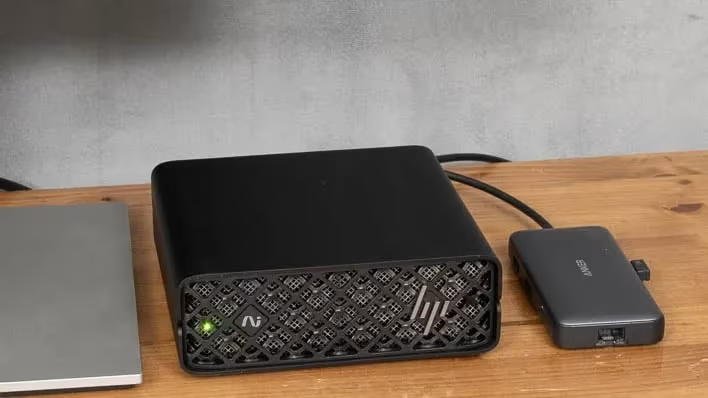
The HP ZGX Nano G1n enters the local AI workstation market, featuring NVIDIA’s Grace Blackwell GB10 Superchip. The system is positioned to compete with high-end machines such as NVIDIA’s DGX Spark and Dell’s Pro Max with GB10. While the core specifications follow the familiar GB10 platform, the unit draws attention for its thermal design and cooling efficiency.
Priced at $5,749 as of October 1, the ZGX Nano G1n is built around 20 Arm cores, 6,144 CUDA cores for AI processing, and 128GB of LPDDR5x memory. This memory offers a peak bandwidth of 273GB per second. Connectivity includes two QSFP ports delivering 200Gbps of aggregate bandwidth via an integrated ConnectX-7 NIC, alongside four USB-C ports, 10Gbps Ethernet, and HDMI 2.1. Users should be aware that the absence of USB Type-A ports necessitates a USB-C dock for standard peripherals.
The ZGX Nano G1n distinguishes itself primarily through its cooling system. The chassis design is significantly more open than competing GB10 systems, allowing noticeable cool air intake. Measurements confirmed that the exhaust temperature under load was notably lower. While the Dell Pro Max with GB10 recorded a temperature of 115 degrees Fahrenheit and produced 46 dBA, the HP system measured just 98 degrees to the touch.
Despite the fans being slightly louder than the competition, the reviewer assessed this as a favorable trade-off for the substantially improved thermal profile. Furthermore, the software environment is largely identical to NVIDIA’s vanilla DGX OS, which operates on Ubuntu 24.04. This similarity ensures full compatibility with other GB10 systems, facilitating seamless multi-node cluster operations, such as those required for NVIDIA’s NCCL playbooks.
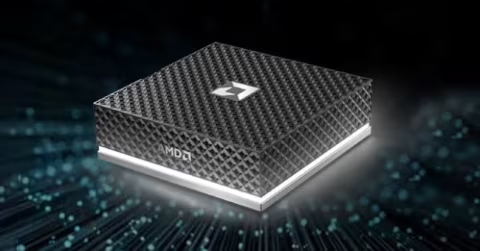
Performance testing utilized Local AI Bench with llama.cpp 0.4.0, comparing the ZGX Nano G1n against AMD’s Ryzen AI Halo and the Apple M5 Pro MacBook Pro. For medium-sized models, token generation showed limited differentiation, with the ZGX Nano G1n maintaining a small advantage largely attributed to its 273GB per second bandwidth compared to the Ryzen AI Halo’s 256GB per second.
However, the divergence becomes clearer during prompt processing. In this area, the NVIDIA system demonstrated a decisive lead over AMD. Prompt processing relies heavily on GPU processing capabilities, specifically involving tokenization and layer-by-layer matrix multiplication. This performance metric governs time-to-first-token. The gap is small in a standard chat scenario, but becomes significant in specialized coding agent workloads.
For large models, the pattern repeated, with the ZGX Nano G1n dominating the AMD competition in prompt processing and holding a small lead in token generation. The Apple M5 Pro MacBook Pro was entirely excluded from the large model charts, failing due to its insufficient 48GB memory capacity for the tested models. The 128GB unified memory pool proved a key advantage for both GB10 systems.
Document embedding tests further reinforced this strength. When ingesting a substantial 131kB text document, the ZGX Nano G1n again performed optimally. The reviewer concluded that the system’s combination of fast prompt processing and document ingestion makes it an exceptional platform for agentic coding workflows, surpassing the Ryzen AI Halo.
The positive aspects include the excellent NVIDIA GB10 software ecosystem, the superior thermal performance relative to peers, and guaranteed compatibility for multi-node builds. Negative considerations involve constant price increases affecting the platform, and the relative assessment that the 128GB capacity may feel limited for extensive local AI workloads.