Apple updated its smallest desktop computer, the Mac Mini, for 2026. The new model is available with a choice between M6 or M5 Pro chipsets, positioning it below the updated Mac Studio as Apple’s entry-level desktop. The M6 model starts at £899 or $899. The more powerful M5 Pro version starts at £1699 or $1699.
Reviewers note that these starting prices represent significant increases over the base M4 model from 2024, which launched at £599 or $599. This price hike is attributed to an ongoing RAM and storage crisis driven by AI data centres.
The M5 Pro unit reviewed features an 18-core CPU and a 20-core GPU, providing 24GB of RAM standard. System upgrades are costly: increasing RAM to 48GB requires an additional £600, while 64GB adds £1000. A fully specified machine, including 64GB of RAM and 8TB of storage, reaches an estimated price point of £7000.
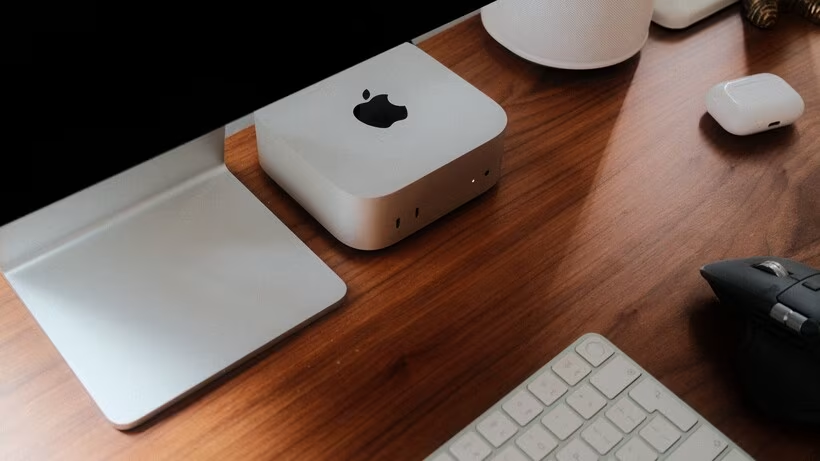
The design retains the familiar form of the M4 model, utilizing a small aluminum chassis. Weighing less than a kilogram and standing just five centimetres tall, the unit’s size has been described as an engineering achievement. Its dimensions make it versatile, suitable for tight desk layouts, placement under a television as a media machine, or transport between locations.
Functionally, the power button remains on the bottom, requiring manual flipping for activation. Connectivity emphasizes USB-C ports. The M5 Pro model includes two USB 3 USB-C ports on the front, offering speeds up to 10Gb/s, alongside a 3.5mm headphone jack. The rear panel features three Thunderbolt 5/USB 4 ports, HDMI, 2.5Gb Ethernet, and a power connector. Conversely, the cheaper M6 version maintains the port count but uses slower Thunderbolt 4 speeds on the rear.
While the reviewer appreciated the port selection for its target market, the lack of a traditional USB-A port was noted. The M5 Pro supports connecting three external displays at 6K/60Hz or 4K/165Hz, or managing a single 8K display. It supports features such as VRR, HDR, and multi-channel audio. An onboard speaker is included, though it is suitable only for alerts and basic listening, leading the reviewer to recommend external speakers for music.
Connectivity standards are handled by an Apple N1 chip, supporting Wi-Fi 7, Bluetooth 6, and Thread. On the performance front, the M5 Pro proved more capable than the M6, despite the latter being the newer chipset. Initial benchmarking results showed strong scores across Geekbench 7, Geekbench 6, and Cinebench 2026. These scores represent an improvement over the M4 Pro and a clear jump past the standard M4, though they come with a substantially higher cost.
Initial impressions suggest the Mac Mini M5 Pro is an impressive option for professionals requiring high power, specifically for AI workflows or high-end video editing. A final verdict and full star rating are pending more extensive testing.