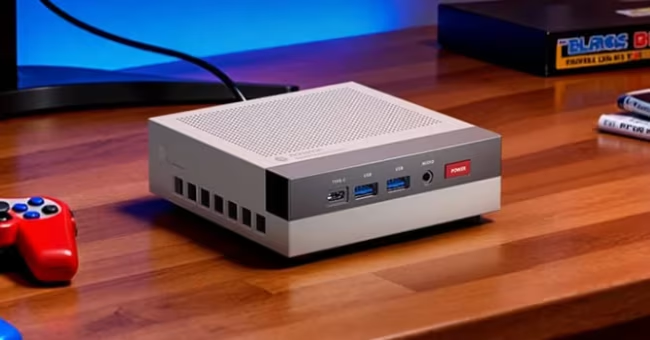
TechPowerUp published a review of the Acemagic Retro X3 on 10 November 2026. The unit steps down in performance from its sibling, the Retro X5, adopting AMD’s Ryzen 7 H 255 and Radeon 780M, replacing the X5’s Zen 5 Ryzen AI 9 HX 370 and Radeon 890M. The systems maintain a shared aesthetic, featuring a grey enclosure and an oversized red power button that mimics late-1980s console styling.
TechPowerUp’s review focused on the performance implications of this hardware downgrade and whether the lower price point makes the X3 a better value for basic work and light gaming. The specification sheet lists the Ryzen 7 H 255, an eight-core, sixteen-thread Zen 4 processor built on a 4nm process. It runs from a 3.8GHz base to a 4.9GHz boost and notably lacks a dedicated NPU.
Graphics handling comes from the Radeon 780M, an integrated RDNA 3 GPU. This unit clocks up to 2.6GHz and utilizes system memory. TechPowerUp characterized the combination as performing reasonably in lighter applications, although demanding titles require lower settings or reduced resolutions.
Connectivity presents a strength for the compact chassis. The front panel includes a 40Gbps USB4 Type-C port, two 10Gbps USB-A ports, and a 3.5mm audio jack. The rear panel adds four 5Gbps USB-A ports, HDMI, DisplayPort, 2.5-gigabit Ethernet, and the DC input. These ports total six USB-A connections, and the USB4 port supports DisplayPort output for a third monitor.
The machine also incorporates advanced networking options, featuring both Wi-Fi 6E and Bluetooth 5.2, alongside the 2.5GbE wired connection. TechPowerUp praised the USB4 inclusion, especially given the competitive price point for the mini-PC.
However, the unit presents clear limitations regarding memory. It ships with 16GB of LPDDR5-6400 memory soldered directly to the motherboard, offering no option for future upgrades. This non-expandable RAM is a key point raised by both TechPowerUp and Notebookcheck.
This memory restriction contrasts sharply with Acemagic’s reported Chinese launch materials, which described a barebones configuration supporting modular RAM up to 128GB. The storage options are more flexible, with two M.2 2280 PCIe 4.0 slots. The review unit included a 1TB Bestoss GM888 drive, though configurations vary.
The chassis dimensions measure 128.2 by 128.2 by 44mm and weigh 528g, utilizing a 120W external adapter. Made of plastic, the design avoids LED decoration, which the outlet cited as a benefit for general office use. The cooling system uses a centrifugal fan with dual heat pipes and separate intake and exhaust paths, supplemented by side ventilation openings.
Notebookcheck provided performance and noise data, finding the Retro X3 becomes clearly audible under heavy load, reaching 50.2 dB(A). Despite the noise level, the unit maintained stable performance and low case temperatures. The outlet’s assessment of the machine is that its appeal rests on design and connectivity rather than raw capability. It remains suitable for office work, media consumption, and lighter 1080p gaming.
Pricing varied significantly across market promotions. TechPowerUp listed approximately $549 for the 512GB model, while Notebookcheck reported a $639 limited deal against a regular price of $899. The single mandatory consideration for buyers remains the fixed 16GB of soldered memory, determining whether the unit suits immediate needs or long-term computing goals.