The AMD Ryzen AI Max+ 395 “Strix Halo” mini PC is being marketed as a dedicated local-AI workstation, designed specifically to run large language models (LLMs) that typically require expensive data-center GPUs. Available in a 128 GB configuration for $4,000, the compact desktop aims to provide powerful AI computing without relying on cloud services or subscriptions.
The machine’s central selling point is its enormous capacity. It features 128 GB of LPDDR5X-8000 unified memory, delivering substantial bandwidth of roughly 256 GB/s. This memory pool allows the system to hold models in the 70–120 billion parameter range, and according to AMD, supports models up to around 200 billion parameters.
This capacity addresses a fundamental limitation of consumer hardware. A typical high-end GPU, such as the RTX 5090, carries a VRAM of just 32 GB. When LLMs exceed this limit, running the models requires slow system memory or device splitting.
Buyers needing to operate these larger models locally find the Halo to be one of the few compact systems capable of the task. The value proposition centers on running private AI without cloud dependency, contrasting the $4,000 cost against the $7,000 price tag of the Nvidia DGX Spark.
Specifications for the Strix Halo include a 16-core, 32-thread Zen 5 CPU, coupled with a Radeon 8060S integrated GPU built on RDNA 3.5. It also integrates an XDNA 2 NPU rated at 50 TOPS, making the system a multi-faceted computational unit.
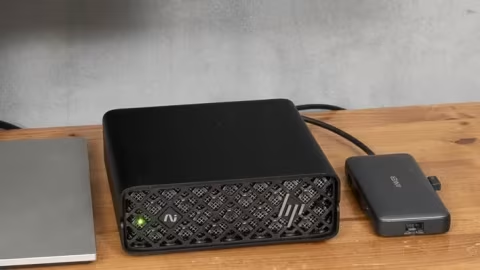
Connectivity and design are comprehensive. The chassis, offered in silver and black, features generous side ventilation and a footprint larger than most traditional office mini-PCs. Input/Output includes two 10 Gbps USB-A ports and a USB4 port on the front, alongside an SD card reader. The rear panel adds a second USB4 port, HDMI, DisplayPort, Ethernet, and three additional USB-A ports.
Operationally, the front-panel button allows users to cycle through Quiet, Balanced, and Performance profiles, which dictates the power draw and cooling intensity of the Ryzen AI Max+ 395. Most testing noted in the review took place under the Balanced profile.
Performance, however, shows mixed results when compared to competitors. While generation speed is described as fairly tied with the DGX Spark, the time-to-first-token relies on raw compute, where the Halo trails. The 256 GB/s memory bandwidth is identified as a limiting factor for the overall token rate. Furthermore, the chip lacks support for FP8/FP4, reducing efficiency when handling modern quantized models, and the PCIe Gen 4 platform slows model loading from the SSD relative to a Gen 5 system.
Despite these technical limitations, the device offers several practical advantages. It supports both Windows and Linux, and the system includes AI software preinstalled. Its private local processing eliminates the ongoing costs associated with cloud services.
The verdict positions the Ryzen AI Max+ 395 not as a general-purpose performance champion, but as a targeted appliance. It is designed specifically for power users, developers, and small teams. For these users who require running frontier-class models locally, the combination of memory capacity, privacy, and relative pricing presents a niche alternative to specialized data-center kits.