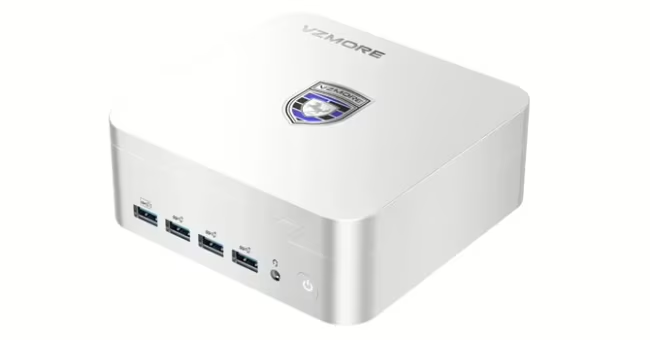
The VZMORE AX9 Max, a Mini-PC built around AMD’s Ryzen AI 9 HX 470, is positioned by reviewers as a premium small desktop. Published in a review on 25 November 2026, the machine features a vapour-chamber cooling system and a connectivity loadout described as generous for its size.
The core processor, the HX 470, belongs to AMD’s Gorgon Point family. It maintains 12 cores and 24 threads, utilizing four Zen 5 cores and eight Zen 5c cores. Performance boosts include a raised boost clock from 5.1GHz to 5.2GHz, and the Radeon 890M graphics clocked up from 2.9GHz to 3.1GHz. The NPU rating increased to 55 TOPS from 50 TOPS.
RZMORE engineered the cooling system using a vapour chamber to manage heat. The unit offers three BIOS-selectable power modes: Silent at 45W, Balanced at 54W, and Performance at 65W. TechPowerUp tested the processor under different modes, noting that the published power figures refer to processor targets, not total system draw.
Gaming results with the Radeon 890M show varied performance. In Cyberpunk 2077, the card averaged 82.47 fps at 720p Medium and 55.30 fps at 720p High. For Baldur’s Gate 3, average frame rates dropped to 49.0 fps at 720p High, and 31.5 fps at 1080p.
Independent testing provided a comparative view. Wccftech recorded 56.08 fps for the HX 470 in The Callisto Protocol at 1080p Medium with FSR2. This performance was compared to the Beelink SER9’s 55.97 fps and the Geekom A9 Max’s 53.82 fps. A notable contrast was provided by the GMKtec EVO X2, equipped with the Radeon 8060S, which reached 96.54 fps in the same test.
Connectivity is a strong point. The chassis includes two 40Gbps USB4 ports, dual 2.5GbE LAN ports, six USB-A ports, an SD card reader, and Wi-Fi 7 support. TechRadar highlighted the port array, particularly the rear placement of USB4 ports, while also mentioning the substantial 120W power supply for the form factor.
Furthermore, the AX9 Max distinguishes itself through its upgrade potential. Users can replace the two DDR5 SO-DIMM modules and add a second NVMe drive via the M.2 2230 slot, complementing the primary M.2 2280 slot.
The review unit came standard with 32GB of DDR5-5600 across two 16GB Micron SO-DIMMs and a 1TB PCIe 4.0 SSD. Notebookcheck measured the Lexar NQ7A1 drive at 1,718 MB/s in a 4K-64 write test. This speed sits 10 percent above the mini-PC class average.
Pricing presents a challenge. TechRadar lists the 32GB/1TB configuration at $1,349. Amazon Canada lists it at CAD $2,236.44. German retail offered it at €1,449 with a discount coupon. TechRadar framed the machine as sitting at the high end of standard mini-PCs, suitable for CPU-heavy work and AI experiments, but warned that reaching its full potential requires a significant investment. The report concludes that while the machine’s build and connectivity are premium, the integrated graphics limit demanding GPU workloads.