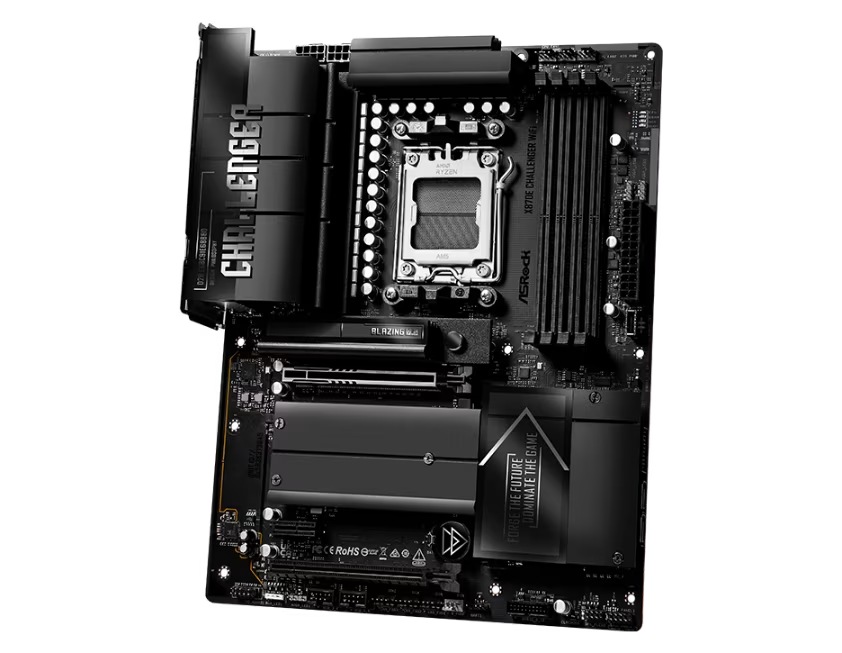
ASRock is entering the enthusiast motherboard market with the X870E Challenger WiFi, an entry-level option designed to offer flagship chipset features at a mainstream price point. The board is priced at $229 USD, £239 in the UK, and CAD $352 in Canada.
This ATX motherboard adopts a functional, black aesthetic, deliberately omitting flashy RGB lighting in favor of a design prioritizing performance and value. Structurally, the PCB is constructed from 8-layer server-grade material, remaining solid and stable despite lacking a backplate.
Performance capability is a core strength. The X870E Challenger WiFi utilizes a 20+2+1 phase power design, featuring 110A Smart Power Stages (SPS). Testing involving a multi-hour PBO stress test, which pushed CPU package power to 146W, showed the VRM peak temperature increased by less than 2°C over stock, confirming substantial thermal capacity.
Connectivity proved to be the board’s major selling point. The rear I/O panel features ten USB-A ports (including three 5Gb/s and five 10Gb/s), two USB-C ports running at 40Gb/s, HDMI, and a 5Gb/s Ethernet port. Wi-Fi 7 antennas and physical Clear CMOS and BIOS Flashback buttons are also included.
For storage, the board supports four M.2 slots, all equipped with heatsinks. One slot runs at PCIe Gen 5 x4, while the other three are Gen 4 x4. The primary Gen 5 slot is placed under the CPU and benefits from a bottom heatsink. ASRock also implemented an EZ release function for this main M.2 slot, although the remaining three slots require a screwdriver.
Networking hardware includes a Realtek 8126 5GbE controller and a Realtek RTL8922AE Wi-Fi 7. The audio is provided by the Realtek ALC4082 codec. Verification testing confirmed full-speed operation across key interfaces; the Gen 5 M.2 slot pushed a drive to its full ~10,000 MB/s rating, and the USB4 ports sustained ~3.8 GB/s.
In benchmark testing using a Ryzen 9 9950X3D2, the board maintained stability, proving its capacity to handle a 200W-class CPU without thermal throttling. The UEFI interface remained stable across weeks of testing, including multiple BIOS resets.
However, two issues warrant attention. The most prominent flaw is the primary PCIe slot’s release latch. With a tower cooler and graphics card installed, the latch is physically inaccessible, creating a genuine frustration for hardware upgraders. Minor usability points include the basic screw-on dipole Wi-Fi antennas and the lack of a proper POST code display found on some competing boards.
Direct rivals in the sub-$350 X870E segment include the Gigabyte X870E Aorus Elite WiFi7 and the MSI MAG X870E Tomahawk WiFi. While the Gigabyte board counters with three Gen5 M.2 slots, it reportedly steps down to 2.5GbE networking and lacks a physical Clear CMOS button. The MSI contender offers an LED POST code display and 5G LAN for a marginal price increase.
The X870E Challenger WiFi remains a strong value proposition. For builders prioritizing functional components and full X870E features without paying a premium price, the board is highly recommended. Its foundation includes a substantial VRM and full-speed verified connectivity, providing a robust platform for high-performance AM5 builds.