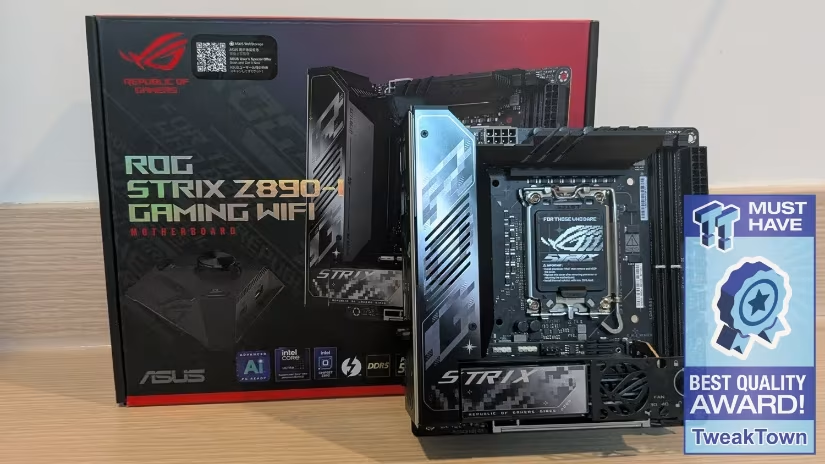
The ASUS ROG Strix Z890-I Gaming Wi-Fi motherboard is a Mini-ITX board for Intel’s LGA 1851 platform, priced at $405. It aims to provide high-end connectivity and cooling within a compact small-form-factor build, positioning it among competitors such as the GIGABYTE Z890I AORUS Ultra and the MSI MPG Z890I Edge Ti.
Despite the Z890 platform nearing the end of its product life cycle and offering no path to future CPU generations, the board remains relevant for 2026 SFF builds, supported by Core Ultra 200S Plus refresh CPUs and its feature set.
To conquer the physical limitations of the Mini-ITX format, ASUS designed two key add-ons. The board utilizes a daughterboard, the ROG FPS II card, which extends functionality by providing two SATA ports, two USB 2.0 headers, a front panel connector, and a PCIe mode switch. Furthermore, the ROG Hive II external USB dock integrates specialized audio components, including a Realtek ALC4050 codec and ESS Sabre 9260Q DAC, along with a programmable flex button and additional USB ports. The Hive II features a magnetic base for mounting to a metal case.
Cooling capability is a primary strength. The board features a 10-phase VRM with 110A stages for VCCCORE. This setup was shown capable of handling a fully loaded Core Ultra 9 285K or 2700K Plus. Even in a cramped Mini-ITX layout, load temperatures peaked at only 61 degrees Celsius. The M.2 cooling solution employs a sandwich-style module, sharing a central heatsink and an embedded fan that draws air from the rear I/O, effectively cooling both PCIe 5.0 SSDs with low noise.
Connectivity boasts numerous ports. The rear I/O panel includes dual Thunderbolt 4 Type-C ports, a 20Gbps Type-C port, and three 10Gbps Type-A ports. The system supports a total of 17 USB ports when accounting for the main board headers and the ROG Hive II. Networking hardware includes an Intel I226-V 2.5G LAN controller and an Intel BE200 Wi-Fi 7 module, which supports 320MHz connections and Bluetooth 5.4. The board supports up to 128GB of DDR5 memory, running at speeds up to DDR5-9200 and beyond. Storage is limited to two M.2 slots, both PCIe 5.0, though the second slot shares bandwidth with the PCIe 5.0 x16 expansion slot. The ROG FPS II card also supplies SATA ports for traditional storage needs.
Testing highlighted the Z890-I’s performance using a Core Ultra 7 270K Plus processor, where it secured the top spot in Cinebench 2024. ASUS’s consistent BIOS updates are noted for keeping performance and stability current. The UEFI BIOS environment is described as mature; while the advanced sections present a steeper learning curve, the EZ-Mode page is user-friendly. The Q-Dashboard page assists troubleshooting by visually confirming populated headers and ports.
Reviewers point to the board’s high-speed RAM support, external audio quality, and dual PCIe 5.0 SSD support as key positives. The main drawbacks mentioned are the high price, which is about $120 more than some competing models, and the lack of a CPU upgrade path. Despite these caveats, the TweakTown overall rating assigned the board an 89%. The verdict maintains that the board’s innovation makes it a fine option for loyal Mini-ITX users, though suggests considering a purchase after end-of-year sales might be wiser.