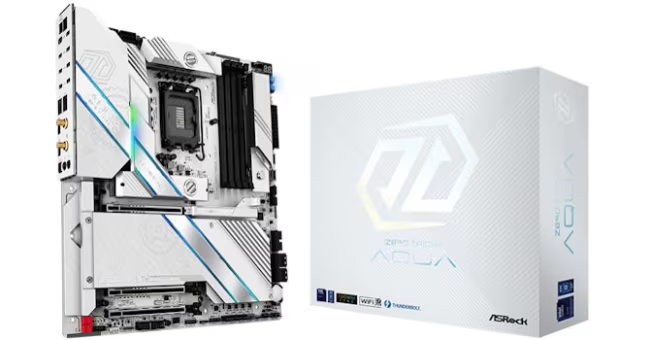
The ASRock Z890 Taichi Aqua, an E-ATX flagship motherboard for the Intel LGA 1851 platform, is generating interest due to a significant price reduction. At $500, the board offers a feature set typically commanding well above $1,000, compelling reviewers who note its value proposition.
TechPowerUp and TweakTown both assessed the unit highly, with TechPowerUp stating it is “one heck of a motherboard for the money.” The pricing makes it one of the cheapest routes available for advanced features like dual PCIe Gen 5 slots, dual PCIe Gen 5 M.2 ports, and 10 Gbps Ethernet connectivity.
The board’s physical design features prominent water-cooling hardware. It ships with a water block covering the VRM and a detachable block for the primary PCIe Gen 5 M.2 slot, a feature ASRock marketed as first of its kind. Reviewers confirmed the VRM block is compact and effective, helping achieve some of the best VRM temperatures recorded.
Connectivity is a standout feature. The rear I/O pane heavily favors USB Type-C, offering a mass of Type-C ports and integrating 10 Gbps Ethernet alongside 5 Gbps LAN and 320 MHz Wi-Fi 7. Storage capability is equally generous, boasting six total M.2 slots and accommodating dual PCIe Gen 5 x16 expansion slots.
However, the design’s focus on Type-C connectivity creates practical hurdles. No integrated Type-A ports are available; these require an included expansion bracket, which provides only two Type-A ports. This Type-C-heavy design has been cited by some users as impractical.
Beyond connectivity, the board delivers class-leading performance in thermal and storage areas. TechPowerUp noted recording the best VRM and PCIe Gen 5 SSD temperatures on the board, a direct result of the integrated cooling systems.
While the water-cooled VRMs and M.2 hardware are strengths, the M.2 water block was deemed less successful, offering limited thermal benefit and restricting access to SSDs. Furthermore, the board’s software experience presents difficulties. The EFI and accompanying software are described as “very dated.”
Other user experience issues include the board’s inability to always recover or retrain effectively after memory overclocking, alongside an EFI that felt sluggish during testing. The required USB BIOS flashback function further adds inconvenience, needing a Type-C compatible USB flash drive.
On the DIY side, the board lacks several modern conveniences. While it has substantial thermal features, it lacks quick-fit connectors and only offers tool-free heatsinks for the single primary M.2 slot.
Despite these architectural and software shortcomings, the board’s current discounted price dramatically shifts its appeal. DVHARDWARE summarized the value as a monster specification that is half the price of competing flagship motherboards.
For builders who prioritize cooling performance and dense connectivity, and are comfortable managing the physical constraints of the Type-C I/O and dated firmware, the Z890 Taichi Aqua remains a highly competitive choice for flagship builders on a budget.