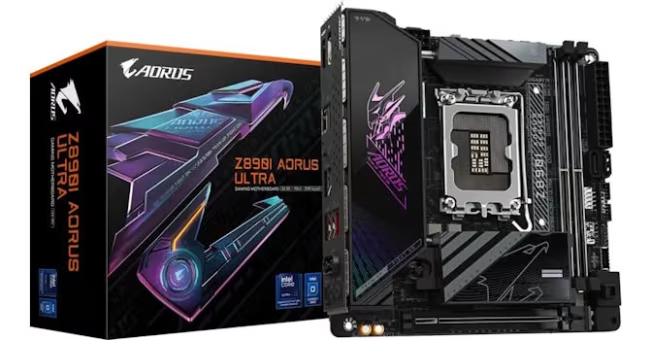
The latest fanless Mini-ITX board for Intel’s LGA1851 platform is drawing attention for its design approach. TechPowerUp’s reviewer, Combatus, assessed the board as “solid,” a verdict characterizing it as performing fundamental tasks well without attempting spectacular features.
The board distinguishes itself through the absence of a VRM fan. Many high-end ITX boards in this class incorporate a small, noisy fan onto the VRM heatsink, making noise a common aspect of sustained performance. Gigabyte changed this dynamic by using an 8+1+2 phase digital VRM with 105A power stages, all housed under a substantial heatsink.
Coverage from DVHARDWARE noted that this passive design leads to a quiet Mini-ITX experience, a point that appears frequently across reviews. For a small-form-factor PC meant for a desk, quiet operation is a substantial benefit.
Beyond noise control, the board also showed strength in thermal management. DVHARDWARE specifically highlighted “strong PCIe Gen 5 SSD thermals.” This is critical because Gen 5 drives generate significant heat, and limited airflow within an ITX case exacerbates this issue.
TweakTown’s earlier review confirmed this point, citing “surprisingly good thermals” and describing the cooling as “very good for an ITX board.” They listed the solid VRM and general cooling as key strengths of the system.
In terms of memory support, the board rates for DDR5-9200 and 128GB across two DIMMs. It features a reinforced memory slot design intended to improve signal integrity. Furthermore, DVHARDWARE summarized the memory overclocking capability as strong, noting the layout is clean and tool-free.
The tool-free design aspect was specifically mentioned as a practical positive. Building ITX boards often involves complicated, fiddly procedures, making a simple assembly process a useful feature for users.
Connectivity signals the board’s target user base. The layout includes two M.2 slots, one of which runs PCIe Gen 5. Users also gain Thunderbolt 4, Wi-Fi 7, and a 2.5-gigabit Ethernet connection.
One functional omission is the removal of integrated HDMI and DisplayPort from the rear panel. This choice assumes the builder will utilize a discrete graphics card, a point praised by one Newegg reviewer who stated they had no need for integrated video ports.
Conversely, the board does present some limitations. Critics point to the price, with DVHARDWARE describing it as “a bit on the high side,” and NTCompatible listing the cost at roughly $341.
Other practical caveats appearing in reports include “limited availability” and a “sub-par audio codec.” The importance of the audio codec issue depends entirely on whether the user plans to use onboard sound, or if they will utilize a USB DAC or dedicated headset.
The overall narrative is a board that prioritizes quiet competence over spec-list dominance. While TweakTown noted it does not win the spec-list battle, the passive cooling system and reliable thermals provide tangible value for ITX builders. For those building a small, quiet Z890 system without needing integrated video outputs, the board represents a sensible choice, justifying the premium price for its passive cooling advantage.