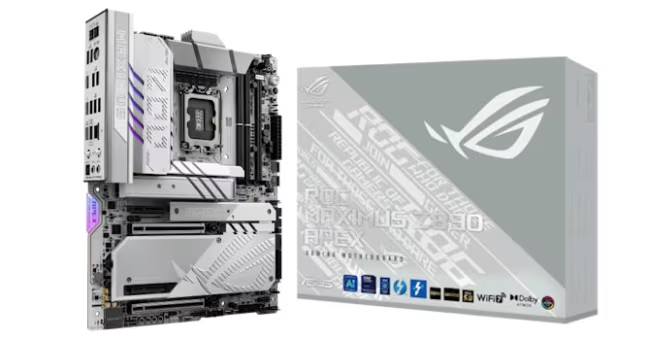
The ASUS ROG Maximus Z890 Apex board, originally released in late 2024, recently underwent a $200 price reduction. This price change prompted TechPowerUp to revisit the motherboard, focusing on its appeal to users seeking extreme memory frequencies.
At its reduced price point, the Apex’s design centers around a two-DIMM slot memory layout, which the manufacturer argues is superior to conventional four-slot boards for advanced DDR5 overclocking. This claim is backed by the board’s architecture, which features a dedicated PCB cutout and a two-slot memory setup.
The board is rated for DDR5-9600 and beyond. Professional overclockers have utilized the Apex to set five world records and a total of thirty-one first places, including a memory frequency run reaching 12,066 MT/s and a CPU overclock of 7488.8 MHz on liquid helium. For regular enthusiasts, the layout simplifies the tuning of high-frequency memory kits, which is the core purpose behind the Apex name.
The power delivery system is designed for extreme loads. TechPowerUp identified a 22-phase CPU power design using Infineon PMC41430 stages, each rated at 110 A. It also includes single-phase 90 A stages for the integrated GPU and VCCSA, and a two-phase 80 A section for VNNAON.
Storage capacity is a key differentiator. The Apex provides six M.2 slots in total: three PCIe Gen 5 x4 and three PCIe Gen 4 x4. This setup is complemented by four SATA ports. For workstation use, a DIMM.2 module adds further M.2 capacity.
Expansion options include a primary PCIe Gen 5 x16 slot, which can configure as x16, x8/x8, or x8/x4/x4. A second Gen 5 x16 slot operates at x8, alongside two additional PCIe Gen 4 x4 slots.
Connectivity features are modern and diverse. The rear panel handles 5 Gbps Ethernet via Realtek’s RTL8126. Wi-Fi 7 connectivity is supported by the RTL8922 module. The panel includes two Thunderbolt 4 ports at 40 Gbps, a 20 Gbps USB 3.2 Gen 2×2 Type-C port, and four USB 3.2 Gen 2 Type-A ports running at 10 Gbps.
The audio system uses the Realtek ALC4080 codec. Cooling is managed by nine four-pin fan headers and a two-pin thermistor header. The board measures 30.5 by 24.4 cm and is an ATX unit.
ASUS included several convenience features, such as M.2 Q-Latch, Q-Release, and Q-Slide for drive installation, along with PCIe Slot Q-Release Slim.
Initial assessments from TweakTown described the board as a “memory overclocking monster” with six M.2 slots and 320 MHz Wi-Fi 7. They cautioned that the board is overkill for users who do not intend to overclock.
While the initial MSRP was $719, a Newegg listing showed the price at $610.99. TechPowerUp’s current reporting of a $200 cut reframes the Apex from a niche flagship to a potentially better value proposition for a specific buyer.
However, owner feedback introduces a caveat. One Newegg customer reported that the board’s AI Overclocking feature caused game crashes when using the automated profile, though manual overclocking resolved the issue. This suggests the Apex requires hands-on tuning rather than one-click optimization.
Ultimately, the ROG Maximus Z890 Apex functions as a specialist motherboard. Its dedication to a two-DIMM layout, coupled with its oversized VRM and extensive M.2 storage, makes it the clear choice for users whose main goal is extracting maximum memory frequency from an Arrow Lake system. The $200 price adjustment makes this high-performance focus more accessible, but the compromises—limited DIMM capacity and high price relative to mainstream boards—keep it strictly in niche territory for general consumers.