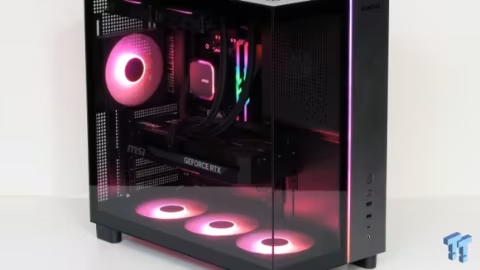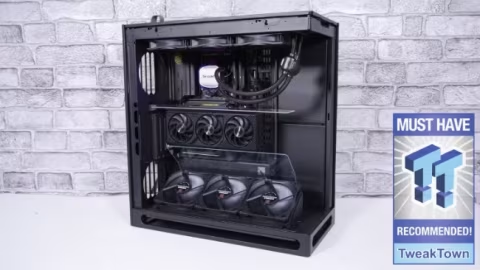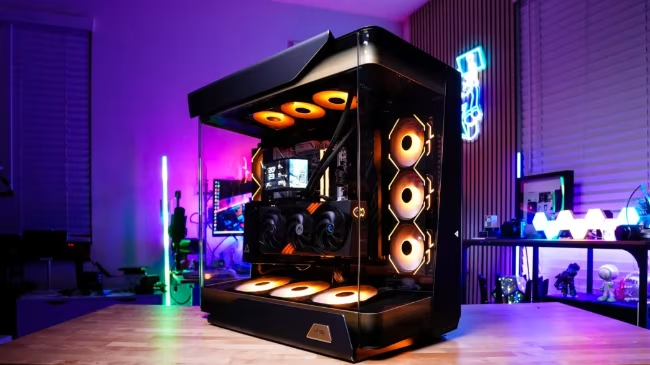
The MSI MEG Maestro 900R is positioned as a full-tower flagship case, boasting dimensions that mandate planning the room around it. Weighing 33kg net, its measured specifications are 695mm deep, 379mm wide, and 671mm tall. The design utilizes aluminum and an elevated base, giving it a finished appearance that resembles furniture more than a standard computing enclosure.
Central to the design is a trio of tempered-glass panels wrapping around the main chamber. This visibility is complemented by a removable motherboard tray, which the source material notes is perhaps the most interesting piece of engineering. This tray functions not only as an open test bench but supports four different motherboard orientations. The manufacturer even included T-handle screws specifically for carrying the tray, suggesting thoughtful attention to the build process.
Technically, the unit is highly accommodating. It supports E-ATX boards, graphics cards up to 440mm, and CPU coolers up to 170mm. Cooling support is extensive, with capacity for up to four 120mm or three 160mm fans in the roof, and similar options on the side and floor. MSI includes three 160mm reverse-blade ARGB fans in the floor as standard, and a PCIe 5.0 riser cable is provided out of the box.
I/O capacity is a key feature. The front panel offers four USB Type-A ports at 5Gbps, four USB Type-C ports at 10Gbps, and a single USB-C port supporting 20Gbps with up to 60W power delivery. This level of connectivity suggests workstation use rather than purely consumer applications. Storage options are equally broad, accommodating up to nine 2.5-inch SSDs or five 3.5-inch hard drives.
The included accessory bundle is extensive. Buyers receive mounting screws, a standoff tool, ten cable ties, and even a separate power-and-reset button set, which allows the test bench tray to operate as a standalone open frame. The packaging itself is designed for careful handling, featuring four base locks that allow the top section to lift off like a television carton.
However, professional reviews present a mixed picture. While the cooling potential is acknowledged—with tests showing temperatures kept under control even with heavy components—critics have focused heavily on the internal construction and workflow. Cable management receives multiple complaints. One review stated that the removable tray forces all cables into a tight space, citing a single hole barely large enough for two fingers. The general consensus noted that the internal design makes the build process unnecessarily difficult for such an expensive chassis.
Concerns also centered on finishing details. Multiple publications described the unit as looking stunning from a distance, but pointing to plastic panels that feel flimsy or a top dust filter that appears unpremium up close. Combined with the high price point and enormous 33kg weight, these perceived flaws create a difficult recommendation for general buyers. The Maestro 900R appears best suited for a user who prioritizes the finished aesthetic and utility of a statement system over a simple, seamless assembly experience.