TweakTown’s Thomas Soderstrom assessed the GAMDIAS Atlas M4, giving the case an 88% overall score and a “Shortlist / Buy” stamp. The evaluation was based on strong feature sets and value, achieving 90% marks in both value and features.
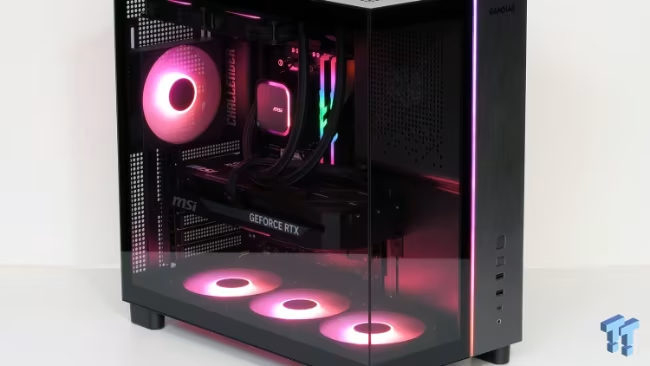
The case is priced at $100 MSRP, with street pricing reported as low as $75. Key features include four pre-installed ARGB fans, an eight-port PWM and ARGB hub, and panoramic glass on both the front and side. It features a front-mounted power supply, a defining visual aspect that extends the power bay past the front glass edge.
Measuring 435mm tall, 450mm deep, and 235mm wide, the chassis weighs 7.12kg and is constructed from steel, tempered glass, and plastic in black and grey hues. The design supports ATX, Micro-ATX, and Mini-ITX motherboards. It accommodates graphics cards up to 425mm and CPU coolers up to 175mm. A 360mm radiator fits in the roof, maintaining 67mm clearance above the motherboard.
Connectivity is handled via the front I/O, which includes one USB-C Gen2x2 port, two USB 3.0 Type-A ports, and a four-pole headset jack. Additionally, the case supports hidden-connector motherboards, allowing cables to plug in from the rear. A pre-installed anti-sag bracket holds the graphics card in place.
Cooling utilizes a chimney principle. Three 120mm NOTUS M1 ARGB fans are mounted to the floor on an adjustable platform, offering six selectable angles aimed at the graphics card. The rear exhaust is managed by a single 120mm fan, which is the only unit in traditional orientation, not reverse-blade.
Power and lighting are centralized by an eight-device ARGB controller with 21 lighting modes. This controller and an eight-fan PWM hub receive power via a SATA cable. These components are controllable from the motherboard using a three-second hold on the front-panel mode button.
Performance testing showed that thermals were respectable. During a one-hour AIDA64 run using a Ryzen 7 7700X and an RTX 5070, the CPU averaged approximately 3.5°C warmer inside the case compared to an open platform. The GPU showed a similar temperature delta.
Noise levels, however, were striking. The closed case measured 9 dB quieter than the bare test bench. Readings of 50.7 dB and 53.1 dB were taken from a quarter-metre distance, positioned at 45 degrees off both the front-left and front-right edges of the case.
The build experience was generally straightforward. The top panel snaps on entirely, and the side panels hook at the bottom and snap at the top. Magnetic dust filters cover the interiors of the top and right panels. A fold-out cover seals the expansion-card screw gap, leaving 24mm of clearance, which is well above the 15mm to 19mm required for easy card installation.
One maintenance consideration involves the intake fans. The three floor-mounted fans have only mesh between the fan basket and the exterior, meaning dust can certainly flow into the case. No dedicated filter is provided for these lower fans.
The primary issue concerns internal cable fitment. The internal power cable reportedly catches on the side of the power supply opening during installation. This bind suggests potential fire risks, though Soderstrom called such extremes unlikely. He tested all common orientations for the ground pin and found every instance suffered the same fitment problem.
To address the issue, Soderstrom suggested two workarounds: an unusual power supply with an offset jack, or an SFX unit paired with an offset full-ATX adapter, such as the SilverStone PP08.
Despite the fitment caveat, the Atlas M4 was recommended to builders who understand the power cable issue and have a suitable fix ready. The case also offers storage for two drives total, with one 3.5-inch bay sharing space with a 2.5-inch mount, plus a second 2.5-inch slot on the opposite side of the tray.
Support included a three-year warranty, and the package contained extra motherboard standoffs, six combo-head power supply screws, and several other hardware components.