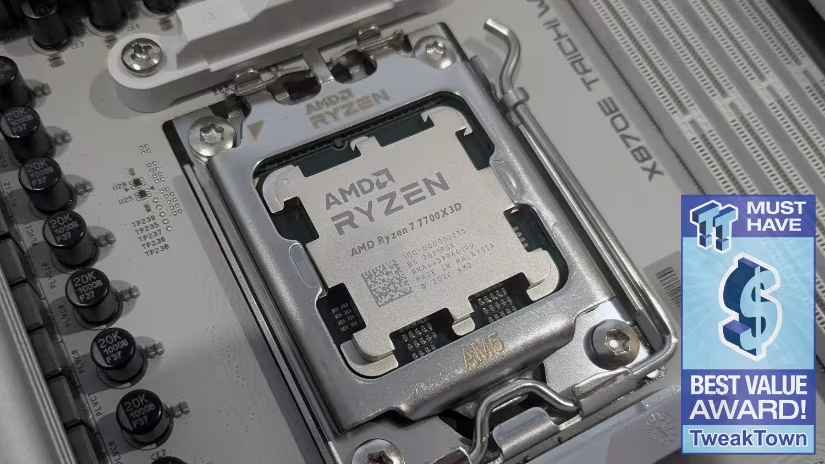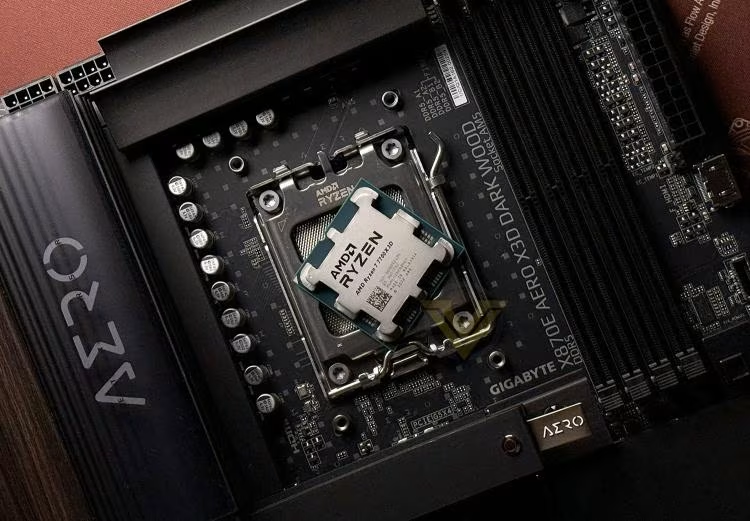
The release of AMD’s 3D V-Cache technology, exemplified by the Ryzen 7 9800X3D, has altered the focus for PC builders and gaming enthusiasts. These X3D processors feature a large amount of L3 cache, such as the 96 MB seen in the 9800X3D, which changes how critical system memory bandwidth is for gaming.
Traditional Ryzen CPUs, utilizing a chiplet design, often presented a latency tax. When a game requested data that missed the cache, the request had to traverse the Infinity Fabric, reach the memory controller, access DRAM, and return. This round trip could impact performance.
The X3D line counters this issue by adding substantial L3 cache on top of the compute die. This enhancement is especially beneficial for gaming, where a working set includes elements like game state, entities, physics, and draw call data. With 96 MB of L3 cache, much of this necessary data can be managed efficiently, reducing the demand placed on DRAM.
This change in architecture means the CPU is optimized to decrease its dependency on frequent memory access, rather than relying on memory acceleration. As cache hit rates improve, the impact of DRAM speed becomes less significant.
Testing showed the disparity. On a standard Ryzen processor, memory latency varied from 71.6 ns on a DDR5-6000 CL30 ULL kit to 89.9 ns on DDR5-4800 JEDEC, representing a 25% latency penalty. While this disparity causes noticeable differences in gaming on typical setups, the X3D series mitigates this effect. In one test, a 25% memory latency difference resulted in only a 2% variance in frame rates.
Dedicated memory workloads, such as y-cruncher, scaled cleanly by about 22% when the latency varied, confirming memory’s role. However, most games do not operate like memory workloads.
Exceptions exist for pure frame chasers. Forza Horizon 6 at 1080p displayed a 12.6% variation in 1% lows and 16.1% in 0.1% lows. Spider-Man Remastered showed 8.8% and 10.6% variations. Cyberpunk 2077 saw variations of 8.5% and 13.6%. These variations correlate with games that use large, irregular data structures, exceeding the 96 MB L3 cache.
The performance impact of other tuning methods is also limited. Enabling Precision Boost Overdrive (PBO) provided modest gains—1.0% in Baldur’s Gate 3 and 0.3% in Counter-Strike 2—with some titles showing no change or a slight regression. In several scenarios, the 9800X3D is often bottlenecked by the GPU, not by clock speed, memory bandwidth, or latency.
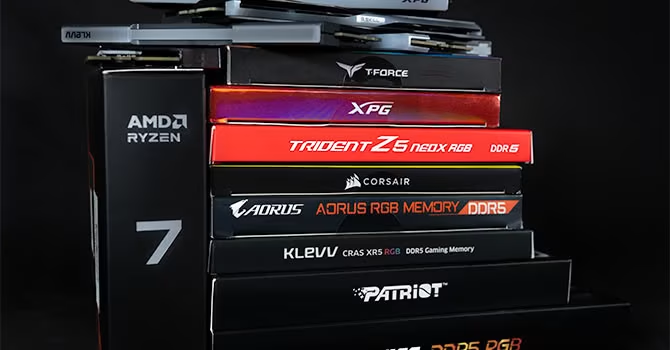
Regarding memory purchases, performance differences narrow greatly. At 1440p resolution, the gap between the most expensive kits and affordable options is indistinguishable outside 0.1% Lows in specific scenarios. If the primary gaming library involves streaming open-world titles with heavy NPC AI at 1080p, investing in a good EXPO kit may be justified. Otherwise, spending on faster DRAM yields diminishing returns. The money saved from not chasing high-end memory could be better spent on the GPU, given that 4K results make the GPU the determining factor in frame rate.