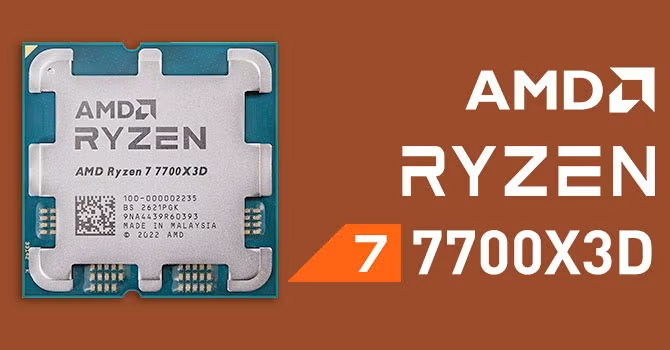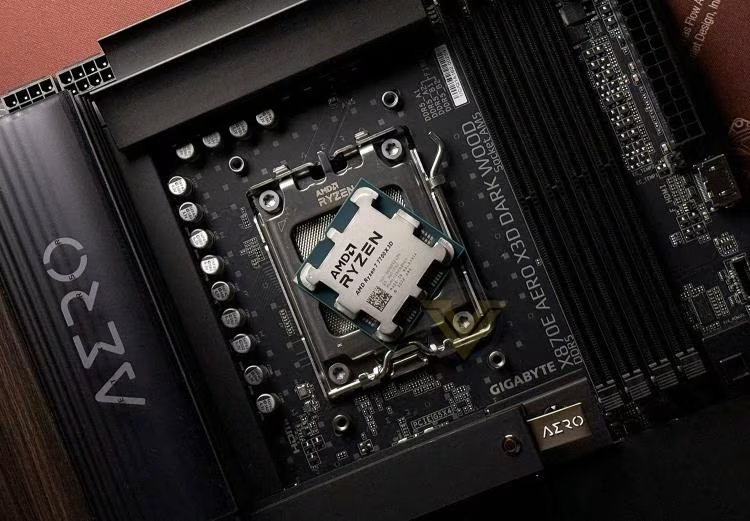
In a review with a reflective tone, AMD’s Ryzen 7 7700X3D is framed as an attractive and budget-conscious option for gamers looking to enter the AM5 platform amid rising costs. The chip operates on Zen 4 architecture using TSMC’s 5nm process, featuring 8 cores and 16 threads.
The technical specifications highlight that the 7700X3D is a downclocked version of the Ryzen 7 7800X3D. It possesses a base clock of 4.0 GHz and a boost clock of 4.5 GHz, which is 500 MHz lower than the 7800X3D’s 5.0 GHz boost. The core cache structure includes a stacked 64MB of 3D V-Cache alongside 32MB of on-die cache, resulting in a total L3 cache capacity of 96MB.
The pricing is noted as a major selling point. With an MSRP of $329, the chip is significantly cheaper than the 7800X3D’s launch price of $449. Reviewers observed that current discounts and anticipated holiday sales could see the price fall below $300, or even to $269, making it a valuable consideration.
Performance testing confirms the chip’s specialization. The X3D cache provides substantial benefits in gaming benchmarks, with results noted across titles like Far Cry 6, which outperformed the cache-less 7700X, and Horizon Zero Dawn, a game known to utilize cache heavily. Cyberpunk 2077 also ranked the X3D chips highly on the charts.
However, performance drops significantly in non-gaming tasks. Cinebench multi-threaded scores were described as “pretty bleak,” and rendering time in Blender is stated plainly: that if content creation is pursued, the 7700X3D is unsuitable. Handbrake video encoding also performed poorly, with reports noting that core count dominates these types of workflows.
The reviewer stressed that the 7700X3D is narrowly defined as a gaming chip, not an all-rounder.
On the topic of efficiency and thermals, the chip performs well. Despite having a 120W TDP and 162W PPT limit, drawing only about 77W during full Cinebench loads was measured. Peak temperature at a 22°C ambient remained at 73°C, which is considered good given the heat-retaining nature of stacked V-Cache. This performance allows it to run without stressing VRMs on budget A620 or B650 boards.
A secondary advantage highlighted is the AM5 platform’s longevity. AMD has guaranteed support for at least another two years, providing a clear upgrade path for future Zen 6 X3D chips. This contrasts with Intel’s Core Ultra 200S series, which was characterized as a “one-and-done platform.”
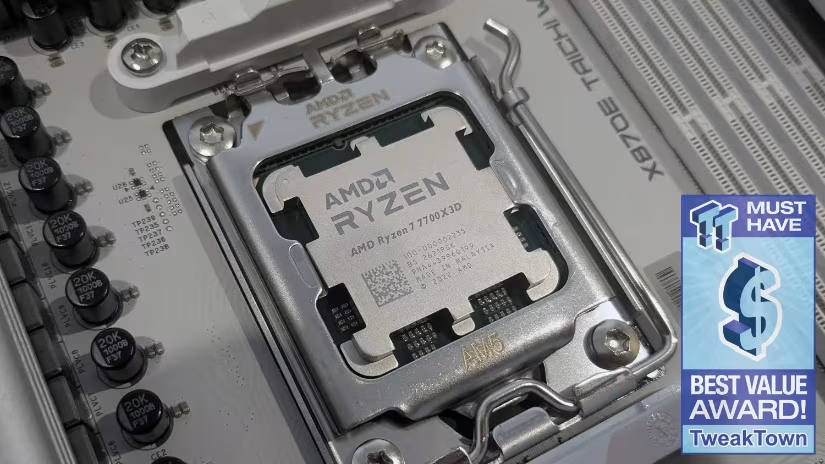
The overall assessment provided an 89% score for the 7700X3D. The review gave high marks for quality (92%) and value (90%), but mandated that buyers be aware of its limitations outside gaming, recommending it particularly if a price drop makes it available below $300.