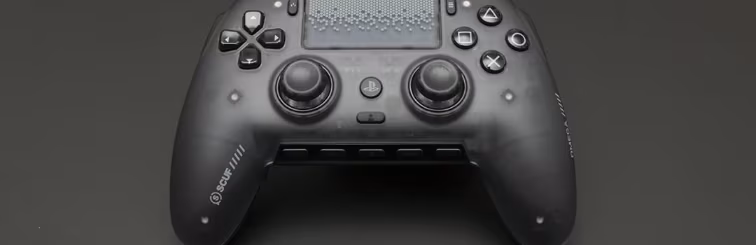
SCUF’s Omega is a performance-focused controller designed for PlayStation 5, PC and mobile devices. APH Networks reviewed the controller and found it combines a familiar PS5-style layout with additional buttons, mechanical switches, TMR thumbsticks and extensive customisation options. The review was published on August 7, 2026.
The Omega is officially licensed for PlayStation 5 and supports Windows 10/11, iOS and Android. It connects using a USB-C cable or a wireless USB-A dongle, while a 3.5mm audio jack provides headset connectivity. The controller has an advertised wireless range of up to 10 metres and weighs approximately 254 grams.
The controller measures 164mm wide, 115mm deep and 64mm high. APH Networks found it slightly bulkier than a standard PS5 controller, while its shorter handles and 254-gram weight make it around 20 grams lighter. Despite the reduced weight, the reviewer said the Omega still felt premium in the hand.
The package includes the controller in a protective case, three additional thumbsticks, two inner paddle blanking plates, two side-action blanking plates, a USB Type-C cable and a 2.4GHz wireless dongle. The reviewer said the controller arrived without visible damage and praised the packaging and quantity of included accessories.
The Omega retains the general button arrangement of a PS5 controller but adds several controls. Its front buttons use Omron mechanical switches rather than conventional rubber domes, producing what APH Networks described as a snappier response. The buttons are magnetically attached, allowing their faces to be replaced.
The two thumbsticks use TMR technology and have textured surfaces for grip. APH Networks found their movement smooth and described the sticks as durable. Different thumbstick surfaces are included so users can adjust the controller to their preference.
The L1 and R1 buttons also use Omron mechanical switches, while the L2 and R2 triggers can operate either as conventional analogue triggers or as instant triggers. A switch underneath the controller allows users to change between the two modes.
The controller provides additional controls through five G-keys, four rear paddles and two side-action buttons. G2 through G4 are assigned to audio functions, while G1 and G5 can be assigned to a wider range of actions. The P1 through P4 paddles and S1 and S2 side buttons can be remapped to other controller functions.
The Omega connects through its USB-C port for wired use and charging, while its included 2.4GHz receiver supports a 1000Hz polling rate. The supplied USB-C cable measures two metres. Bluetooth connectivity is also available, although APH Networks notes that Bluetooth is intended for PC and phone use rather than PS5.
Customisation is handled through the SCUF App, available through Google Play and Apple’s App Store. The application allows users to calibrate triggers and thumbsticks, create different profiles, adjust lighting effects and remap buttons. Keyboard keys can also be assigned to the controller when used with a PC.
The reviewer tested the Omega on both PC and PS5 across several genres, including first-person shooters, real-time turn-based games and third-person survival games. In Call of Duty: Black Ops 3, the buttons and thumbsticks were described as responsive and immediate, although the reviewer sometimes accidentally pressed the side buttons. The included blanking plates can be used to prevent such accidental inputs.
Testing with Clair Obscur: Expedition 33 highlighted the mechanical switches, with the reviewer finding the inputs snappy compared with a standard PS5 controller. In Palworld, the reviewer found navigation smooth and controlled, with the TMR thumbsticks providing precise movement.
Battery life was another strong point. SCUF rates the Omega for up to 17 hours of battery life, and APH Networks found the claim to be essentially accurate during testing. The reviewer compared this favourably with the approximately six-hour battery life cited for the DualSense Edge.
The reviewer did identify several limitations. The Omega’s bulkier shape was somewhat less comfortable than the standard PS5 controller, although this was described as a minor issue. G2 through G4 cannot be assigned to general controller actions, instead being restricted to audio functions, and those audio controls only operate with a headset connected to the controller.
On PS5, users must use either wired or 2.4GHz connectivity. Switching between connection modes and PS5 or PC modes requires removing the faceplate and changing the relevant switch. The reviewer also noted that licensing restrictions mean the PS button cannot be used to turn on the PS5 or synchronise when shutting down.
APH Networks concluded that the SCUF Omega is a strong contender among PS5-style controllers, citing its mechanical switches, extensive customisation, interchangeable components and battery life. The review gave the controller a final score of 7.4 out of 10 and listed an MSRP of $220.
The review ultimately described the Omega as a PlayStation 5 mechanical-switch controller that can be tailored to almost all of a user’s needs. Its combination of additional controls, configurable triggers, TMR thumbsticks and software-based remapping provides the main distinction from a standard PS5 controller.
Reviews · Review digest
SCUF Omega Review: Custom PS5 Controller with Mechanical Switches
APN reviewed the SCUF Omega, a performance controller for PS5/PC featuring mechanical switches and TMR thumbsticks. It offers extensive customization through an app, boosting functionality over standard controls.