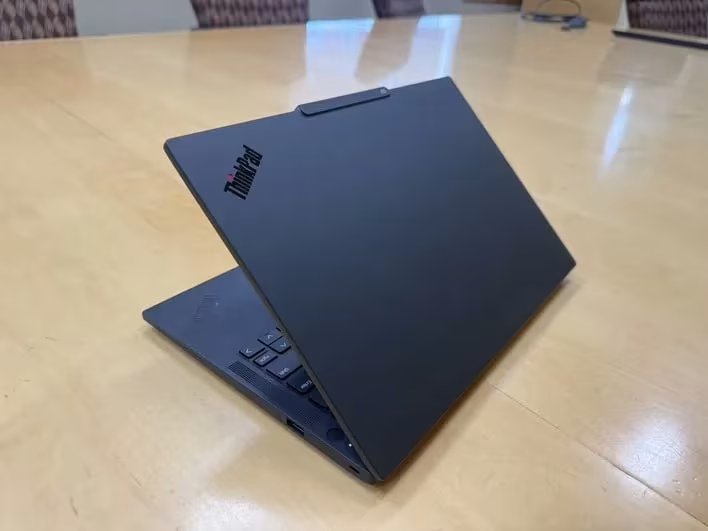
Lenovo’s ThinkPad X13 Gen 6 is designed as a compact business laptop for enterprise users and frequent travellers, with HotHardware highlighting its sub-kilogram weight, quiet operation and focus on portability. The review unit weighs 962 grams, or roughly 2.12 pounds, and uses Intel’s Core Ultra 7 225U processor.
The laptop retains the familiar ThinkPad design, including a matte-black chassis and red TrackPoint. HotHardware found the build solid, with little flex despite the machine’s thin construction. The review identifies portability as one of the system’s major strengths.
Connectivity includes two Thunderbolt 4/USB4 Type-C ports with DisplayPort 2.1 and Power Delivery, a full-size HDMI 2.1 output and a 3.5mm audio jack on the left side. The right side has a USB-A 3.2 Gen 1 port with Always On charging. There is no SD card reader.
The ThinkPad’s keyboard is another highlight of the review. HotHardware found the key travel and feedback satisfying during extended typing, while the TrackPoint and its dedicated buttons remained responsive. The touchpad was described as a good size for a 13-inch laptop, with smooth operation, good responsiveness and accurate tracking.
The 13.3-inch WUXGA IPS display produces vibrant colours and good viewing angles, with coverage of the full sRGB colour gamut. HotHardware found colour reproduction accurate across different types of content, while the anti-glare coating helped diffuse indoor ambient light. However, the panel remained susceptible to glare under direct or bright lighting.
The software experience is relatively clean. The laptop runs Windows 11 Pro and includes Lenovo Commercial Vantage as its primary management utility. The application provides driver and firmware updates, hardware diagnostics, battery-health settings and system information without creating significant notification or taskbar clutter.
Storage performance was measured using ATTO, with the Gen 4 NVMe SSD reaching more than 6.6GB/s in sequential reads and averaging approximately 5.5GB/s in writes after reaching full speed. HotHardware said these figures were below the fastest Gen 4 SSDs but appropriate for a thin business-class laptop.
In Speedometer 3, the ThinkPad X13 Gen 6 scored 35.6 while connected to AC power, placing it in the middle of the comparison group. On battery power, however, the score fell to 22.6, representing one of the largest performance reductions among the tested systems.
PCMark 10 produced an overall score of 15,887, with the laptop outperforming several systems using comparable or nominally faster processors. Its Excel sub-score of 24,448 was the highest among the U-series and similarly configured machines in the comparison. Heavier multi-threaded workloads favoured systems with higher-power processors and additional thermal headroom.
Geekbench 6 produced scores of 2,460 for single-threaded performance and 10,734 for multi-threaded performance. HotHardware recorded these as the lowest results in its comparison group, while noting that the results reflect the lower core count and thermal design of the Core Ultra 7 225U.
Cinebench 2026 showed stronger single-core performance, with a score of 602 on AC power. The multi-core score was 2,247, while running the test on battery reduced that result to 1,396, a decline of approximately 38 percent. HotHardware described this as the largest battery-to-AC multi-thread performance reduction in its test group.
Graphics performance was considerably weaker. In 3DMark Steel Nomad Lite, the X13 Gen 6 recorded 13.63 frames per second, the lowest result in the comparison group. Gaming tests produced averages of 22 frames per second in F1 2025 and 12.4 frames per second in Talos Principle 2, also the lowest results among the tested systems.
The laptop also recorded a Procyon AI Integer score of 686, placing it second from the bottom in the review’s comparison. In DaVinci Resolve 20.3, however, the X13 achieved a score of 2,215, ahead of the HP OmniBook X and narrowly ahead of the Dell Pro 14 Premium. HotHardware said the system was suitable for light editing, while its integrated graphics became a limitation for heavier workloads.
Battery life was one of the X13 Gen 6’s strongest results. In HotHardware’s PCMark 10 video playback test, the laptop lasted 1,056 minutes, or 17.6 hours, placing fifth among nine tested systems. When adjusted for battery capacity, it achieved 19.3 minutes per watt-hour, the third-highest result in the group.
Thermal testing showed the processor reaching approximately 95°C during sustained Word and Excel workloads. HotHardware did not observe hard thermal throttling, although sustained boost frequencies were inconsistent during some runs. When workloads became lighter, temperatures quickly returned to approximately 45–65°C.
Acoustically, the ThinkPad X13 Gen 6 measured around 31dB at idle and approximately 38–39dB under sustained CPU load. The fans remained active at low speeds even while idle, but HotHardware found them nearly inaudible in a typical office environment. Under heavier workloads, the fan response was prompt and the resulting noise was described as noticeable but not intrusive.
HotHardware ultimately characterised the ThinkPad X13 Gen 6 as a well-rounded business laptop suited to office productivity, communications, web use and light content creation. Its strengths include its 2.1-pound weight, battery life, keyboard and quiet acoustic profile, while its limitations include weaker multi-threaded, GPU and NPU performance, significant reductions in performance on battery power, display glare in bright environments and soldered memory with no upgrade path. The review lists the laptop at around $1,476 at Amazon at the time of testing.
Notebook · Review digest
Review: ThinkPad X13 Gen 6 – A Compact Laptop Built for Business
The Lenovo ThinkPad X13 Gen 6 is a portable business machine, praised for its sub-kilogram weight and superb battery life (up to 17.6 hours). While excelling in productivity, it shows weaker performance in graphics and multi-threaded tasks.