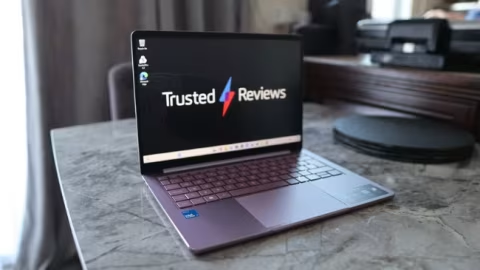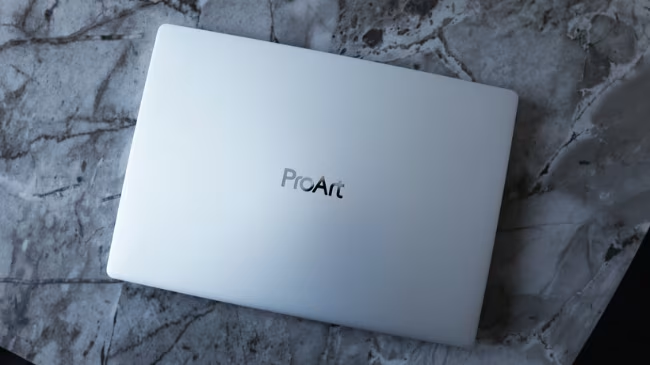
The Asus ProArt P14 introduces a highly capable creator platform built around Nvidia’s RTX Spark superchip. Weighing 1.48kg and measuring only 13.9mm thick, the 14-inch machine manages to retain an impressively generous selection of ports.
The port array includes two 40Gbps USB4 Type-C ports, a full-size HDMI output, a 3.5mm headphone jack, a dedicated full-size SD card reader, and a separate USB-A port. Maintaining this port selection while shrinking the form factor is a key design achievement for the unit.
The price for the 32GB configuration stands at £3,199.99/$3,099.99. The premium pricing is offset by the high-specification 14-inch screen. This Lumina Pro tandem OLED displays at 3K resolution (2880×1880) and a refresh rate of 120Hz.
Technical specs for the display are strong: it features a peak SDR brightness of 624.3 nits, can reach 1600 nits in HDR, and boasts a black level of 0.01. Color coverage remains highly capable, hitting 100% sRGB, 100% DCI-P3, and 94% Adobe RGB.
Inputs and outputs are refined, too. The speakers are described as rivaling those found in a 16-inch M1 Pro MacBook Pro, while the keyboard offers deeper travel than a MacBook Pro and uses a bright white backlight. The trackpad is large and provides responsive tracking and pleasant haptics.
One functional omission from previous ProArt models is the DialPad jogwheel.
Powering the device is the N1X version of the RTX Spark. This integrated system pairs a 20-core Grace CPU, co-developed with MediaTek (combining 10 Cortex X-925 performance cores and 10 Cortex A725 efficiency cores), with an RTX Blackwell GPU containing 6,144 CUDA cores. The GPU operates within a scalable 45W to 80W TDP.
Memory capacity reaches 128GB of unified LPDDR5X, operating at over 9400MT/s. This sample unit includes 32GB of memory.
Benchmark testing shows strong performance across the board. Geekbench 6 recorded a multi-core score of 19,171, surpassing the Core Ultra X9 388H and the Ryzen AI Max+ 395. The GPU performance is substantial, yielding 10,131 in 3DMark Time Spy, a figure more than double the Adreno graphics found in the Zenbook A16.
In gaming scenarios, the machine shows varying levels of performance. At 1080p, the GPU delivers 61.53fps in Cyberpunk 2077 and 55fps in Returnal. While native ray-traced performance drops dramatically, the second-generation Transformer model using DLSS lifts 1080p raster rates to 66.87fps. Multi-frame generation can further push frames to 186fps in Cyberpunk 2077 at 1080p.
The unit’s local AI capabilities are impressive. Running Llama 3.1 8B averages 52.0 tokens per second on llama.cpp. The time to first token on 8B-class models is reported at around a tenth of a second. However, the 32GB memory on this sample remains a limiting factor for running larger models.
Battery endurance is a standout feature. The 90Whr cell lasted 13 hours and 43 minutes during a 1080p video loop at 150 nits. This runtime provides roughly three hours more than the RTX 5070-powered ProArt and two hours more than a MacBook Pro M4.
Charging remains quick, with the bundled 140W charger achieving 50% charge in 27 minutes and full charge within 90 minutes.
The software package runs Windows 11, incorporating Copilot+ PC features. Asus contributes its own software tools, including GlideX and StoryCube for AI photo organization.
The reviewer concluded that the machine is a compelling showcase for the Nvidia chip. While it sacrifices some raw gaming performance compared to a discrete RTX 5070, the trade-off for a lighter chassis, improved portability, and approximately three hours of additional battery life is deemed worthwhile.