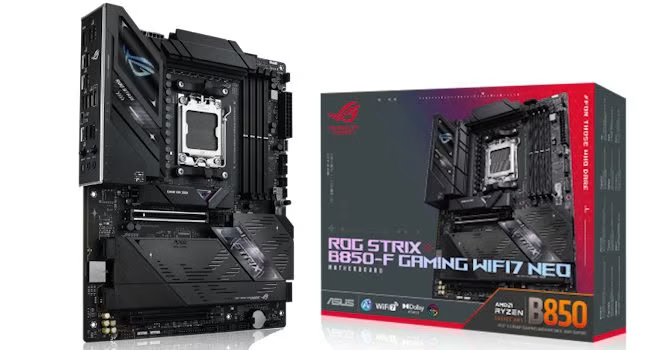
ASUS has introduced its successor to the original ROG Strix B850-F Gaming Wi-Fi7, naming it the ROG Strix B850-F Gaming Wi-Fi7 Neo. This new board aims to address certain aspects of the older model.
The updates include a larger 512 Mbit (64 MB) BIOS preloaded with a Wi-Fi driver. The design is noted as being more DIY-focused, and it features enhancements in networking and USB speeds. It also comes with a newer EFI and software suite, although these components may be available for older models.
While the overall refreshment of AMD’s 800-series chipsets has been generally disappointing in terms of value—as predecessors remain available at lower prices—the article details the specific improvements of the Neo model compared to its original counterpart. The predecessor board has seen a price cut, potentially saving up to $50.
The key upgrades on the Neo include a completely tool-free lower M.2 heatsink, which is easier to use. Furthermore, the front Type-C header now supports USB 3.2 Gen 2×2 at 20 Gbps, an upgrade from the slower 10 Gbps support of the older board. The Ethernet controller speed has also doubled, moving from 2.5 Gbps to 5 Gbps.
The new motherboard also equips the rear I/O panel with more higher-speed USB ports and adds a second USB 3.0 header.
Other changes include a larger 512 Mbit (64 MB) BIOS, although this primarily provides an advantage through the integrated Wi-Fi driver.
The article notes that bandwidth sharing has not been improved and was not originally a significant issue for this particular board.
When comparing the Neo to competitors, several options are mentioned. For example, the ASRock Phantom Gaming X870 Riptide Wi-Fi offers USB4, two extra SATA ports, and good thermal management for $180. However, its EFI and software are described as far inferior to those of the ASUS board.
A more balanced choice is the MSI MAG X870E Tomahawk Max Wi-Fi, which costs $260. This model offers USB4, additional bandwidth, 27 W power delivery over its Type-C header, plus two extra SATA ports and three video outputs.
Alternative ASUS options include the ASUS TUF Gaming B850-Pro Wi-Fi7 Neo, priced about $80 less than the main board, or the Gigabyte B850 Aorus Elite Wi-Fi7. Both offer a larger BIOS, similar EFI/software, and USB 3.2 Gen 2×2 20 Gbps Type-C header.
Other competitors noted include the ASRock B850 Steel Legend Wi-Fi at $170, which offers solid performance, decent audio, a 20 Gbps Type-C front panel header, thermistor header, four SATA ports, and Wi-Fi 7. The ASUS board maintains an edge in faster Ethernet speed, better software, and more modern DIY features.
The high-end competition includes the Gigabyte X870E Aorus Pro X3D Ice ($340). While its EFI/software might be less robust than ASUS, it provides excellent VRM and SSD cooling, higher fan header power, USB4, four SATA ports, three rear video outputs, and specialized tools like an LED POST code display.
The author concludes that the ROG Strix B850-F Gaming Wi-Fi7 Neo performs well relative to other ASUS boards, offering solid VRM and SSD temperature management. Despite being somewhat pricey, its combined features and latest ASUS software package make it a strong option for those who value advanced software integration or high performance.