The Acer Swift Go 14 AI (2026) arrives as a Windows laptop that reviewers describe as a balanced choice, offering solid performance and exceptional battery life without challenging flagship prices. Priced at £1,299 for the review unit, the machine utilizes a mid-range Intel Core Ultra 7 355 chip, designed to balance endurance and power rather than focus solely on peak performance.
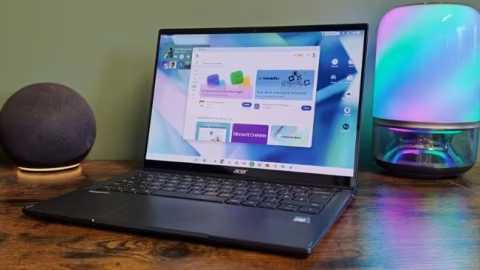
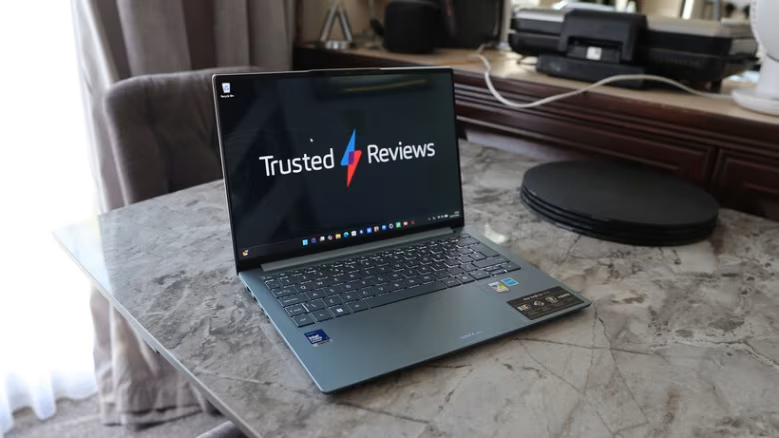
The laptop has undergone a visual refresh. It replaces older grey models with a pleasant blue color scheme accented by silver. Constructed mainly from anodised aluminium, the design keeps the overall weight at a light 1.24kg.
A key feature highlighted by the review is its port selection. For such a thin chassis, the Swift Go 14 AI includes a robust array of connectivity options: a pair of USB4-capable Type-C ports, two traditional USB-A ports, a full-size HDMI port, a 3.5mm headphone jack, and a microSD reader.
The OLED screen measures 14 inches and delivers a contrast ratio of 13,610:1, providing deep blacks and high contrast. Colour accuracy is excellent, hitting 100% sRGB and 99% DCI-P3 coverage. Despite these strengths, the display’s 1920×1200 resolution and 60Hz refresh rate are identified as limitations compared to some competitors.
Typing comfort is high, thanks to a tactile keyboard. The trackpad offers a smooth feel and is made from recycled ocean-bound plastic.
Under the hood, the Core Ultra 7 355 Panther Lake chip provides decent strength in both single and multi-threaded tasks. While performance shows gains, it only moves a small margin from last year’s Core Ultra 7 255. The integrated graphics are reasonable, although they fall short of the beefier Arc B390 found in higher-end Panther Lake components, limiting its use for sustained gaming or creative work.
The laptop is equipped with 16GB of RAM and a 512GB PCIe Gen 4 SSD. The storage capacity feels somewhat limited for this price point. However, the drive’s speed is brisk, achieving measured reads of 7087.70 MB/s and writes of 5666.23 MB/s.
Functionally, the machine operates as a Copilot+ PC, incorporating Microsoft’s AI tools. Among these, Windows Studio effects for the webcam are useful, providing capabilities like auto-framing, background blur, and eye contact features.
Battery endurance stands out as the device’s standout feature. Testing with the PCMark 10 video loop yielded a runtime of 20 hours and 51 minutes. This capacity is sufficient for two to three working days before needing a recharge.
Powering the machine is a 65W charger. It charges quickly, taking 35 minutes to reach 50% and a total of 75 minutes to complete a full charge.
While the downward-firing speakers are described as merely adequate for casual use, they lack the crispness and body found in stronger audio options. The overall conclusion points to the Swift Go 14 AI (2026) as a highly balanced selection in its price bracket. Its combination of portability, reliable connectivity, and superior endurance makes it a compelling alternative to pricier rivals, including the Dell XPS 14 (2026) and the Asus Zenbook A14 (2026).
The machine is best suited for users who prioritize all-day battery life and extensive connectivity over achieving the sharpest possible display resolution and refresh rate.