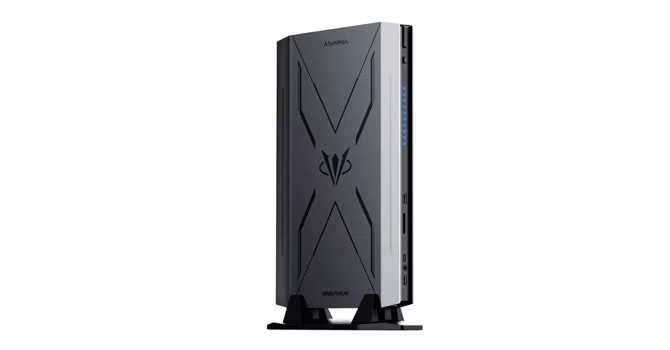
The MINISFORUM AtomMan G7 Pro is presented as a gaming-focused Mini-PC designed to offer strong performance while maintaining a small footprint. It incorporates laptop-class hardware, pairing Intel’s Core i9-14900HX with an NVIDIA GeForce RTX 5070 Laptop GPU, housed within a tall, thin vertical chassis.
This configuration targets users who desire strong gaming and graphics performance exceeding typical Mini-PCs, without needing a traditional desktop tower. While larger than usual compact office-style Mini-PCs, this size allowance accommodates hardware necessary for a robust gaming experience and fast general desktop performance.
Technically, the G7 Pro supports up to 96 GB of DDR5 memory and features two M.2 2280 SSD slots. Connectivity options include USB4, HDMI 2.1, 2.5GbE, Wi-Fi 7, Bluetooth 5.4, and an SD card reader.
The cooling system is notable, featuring a dual-fan setup, six heat pipes, and a three-sided exhaust layout. The unit also includes physical switches for Work Mode and Game Mode, alongside control software that manages fan settings, RGB lighting, and system monitoring.
The GeForce RTX 5070 Laptop GPU is based on NVIDIA’s Blackwell architecture, offering 4,608 CUDA cores, 8 GB of GDDR7 memory, and 384 GB/s of memory bandwidth. This hardware is described as delivering very good 1080p gaming performance, with 1440p also achievable in several titles depending on settings and DLSS usage.
In performance testing, the G7 Pro showed strong 1080p results. Cyberpunk 2077 achieved 147.21 FPS at 1080p Medium, while Baldur’s Gate 3 reached 193.3 FPS at 1080p Medium. For esports titles, Counter-Strike 2 averaged 259.1 FPS at 1080p High. At 1440p, the unit posted 94.25 FPS in Cyberpunk 2077 at High settings.
Beyond gaming, the system exhibited high processing power, with benchmarks like PCMark 10 recording 9,666 overall, and the Digital Content Creation score achieving 15,343. These results indicate that the machine handles web work, multitasking, office applications, and content creation quickly.
Workstation capabilities were also strong, particularly with SPECviewperf testing in Maya, Creo, and 3ds Max. The system functions as more than just a compact gaming box, offering value for 3D work and heavier GPU-driven professional tasks.
Connectivity includes a front panel with USB-A, USB-C data, and an SD card slot, and a rear panel featuring USB4, HDMI 2.1, 2.5 GbE, and an additional USB-A port. Current wireless support is provided by Wi-Fi 7 and Bluetooth 5.4.
Regarding usability, the G7 Pro is reviewed as feeling sturdy, resembling a compact desktop replacement. The physical mode toggle between Gaming Mode and Work Mode is reported to be useful, altering both fan noise and overall system performance.
In terms of acoustics, the unit was quiet during lighter use, staying at 34 dB(A) or lower. However, Gaming Mode can ramp up fan noise to 60 dB(A) under heavy load, while Work Mode tops out around 45 dB(A) in Cinebench, making the difference noticeable.
Pricing the 32 GB RAM and 1 TB SSD configuration at approximately $2,300 USD, the G7 Pro is positioned as a premium compact gaming system. It is competitive against rivals like ASUS’s ROG NUC/NUC series, offering comparable hardware in a compact form factor.
Overall, the G7 Pro offers a balance of gaming performance and professional capability in a compact chassis, making it suitable for demanding users who require both portability and power.