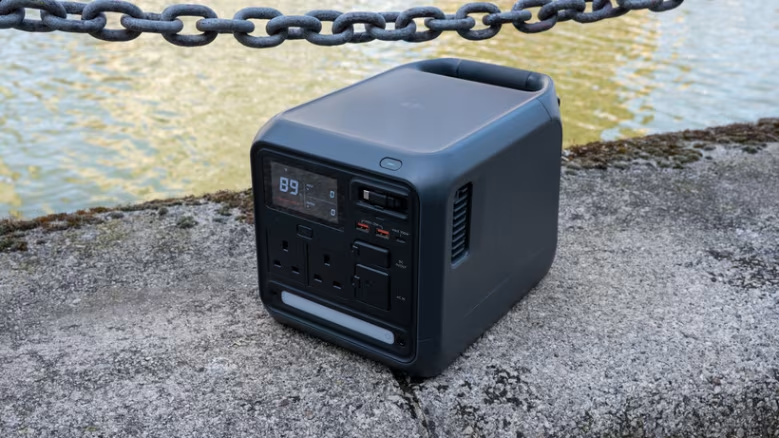
Trusted Reviews tested the DJI Power 1000 Mini, characterizing it as a compact, well-priced portable power station ideally suited for camping trips. The unit features a 1008Wh lithium-ion battery capacity. This output is achieved within a chassis that occupies less space than a 500Wh unit from previous years, despite retaining a substantial weight of 11.5kg. The high capacity relative to its dimensions stands out, matching the original DJI Power 1000’s capacity while taking up significantly less physical space.
The power station offers diverse port selection, concentrating most outputs on the front panel. These include two UK AC sockets, a USB-C port with a 100W capability, and dual USB-A ports, which supply a maximum of 12W. Convenience is built in via an integrated USB-C charging cable. A display panel monitors the remaining runtime, input and output power, and battery percentage.
Power inputs include an IEC AC input, which can charge the unit at a maximum of 1000W, fully replenishing the battery in just over an hour. The unit also supports solar charging, drawing up to 400W through the DC socket, enough to fully charge the device in roughly three hours, depending on available sunlight.
Performance efficiency varied significantly depending on the load. When running a 1000W heater until the battery depleted, the charge cycle efficiency dropped to 79.56%. However, testing at a 500W load improved efficiency to 85.22%. Efficiency was even higher when utilizing the DC output via the USB ports, reaching 91.26%. The round-trip AC efficiency registered a modest 75.7%.
Beyond power delivery metrics, the DJI unit boasts a long lifespan. The battery is rated for up to 4000 charge cycles before reaching 80% capacity. Over its operational lifetime, this translates to an estimated cost of 12p per kWh of stored power.
Purchasing considerations reveal both strengths and limitations. Buyers needing a small, inexpensive generator for typical camping tasks, such as running laptops, lamps, or pumps, may find this a strong option. Conversely, users requiring expanded capacity, higher overall output, or better efficiency should consider alternative models.
Key drawbacks include the mid-level round-trip efficiency and the limitation of the non-standard 12V output, which uses proprietary DJI cables rather than a standard 12V car port. Furthermore, there are no options available for adding additional batteries to increase the overall capacity, nor does the unit handle power outputs exceeding its 1000W maximum.
Despite its moderate efficiency ratings and capacity limits, the compact nature and initial cost make the DJI Power 1000 Mini a strong choice for its intended use case when camping, according to Trusted Reviews.