The Samsung Galaxy Book 6 is positioned as the most affordable option within Samsung’s 2026 laptop lineup, retailing at £1,049 or $1,249. Trusted Reviews characterizes it as a sturdy entry point, featuring an aluminum build and adequate ports. However, the reviewer notes its 60Hz screen and performance metrics prevent it from competing with stronger alternatives.
The sample unit is equipped with Intel’s Core 5 315 processor, part of the new Wildcat Lake chips designed for budget-conscious laptops. The machine includes 16GB of DDR5 RAM, a 512GB SSD, and a 14-inch 1920×1200 60Hz IPS screen. The processor has six cores and six threads, distributed across two Performance cores and four Low Power Efficiency cores, achieving a boost clock up to 4.5GHz.
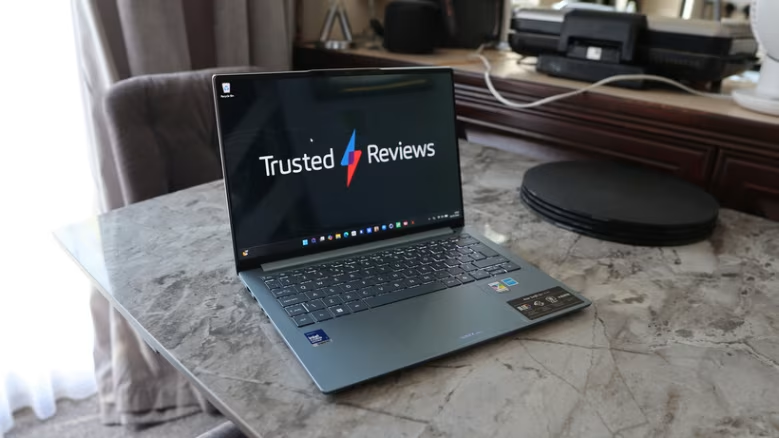
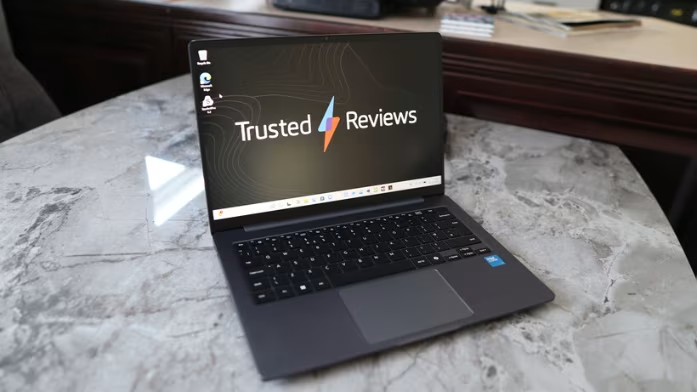
In design, the Galaxy Book 6 adopts Samsung’s typical aesthetic, sporting a space grey finish and an aluminum chassis that draws comparisons to the MacBook Pro. Weighing 1.35kg, it offers decent portability for a 14-inch machine, though it exceeds the weight of some other ultrabooks.
The port selection is surprisingly comprehensive given the price point. The left side accommodates two USB-C ports and a full-sized HDMI port. The right side features a USB-A port and a headphone jack. Usage of the USB-C ports is limited to USB 3.2 Gen 2, not the faster Thunderbolt 4 found on rival machines.
Beyond connectivity, the user interface includes a functional keyboard with a small form-factor layout and a function row. While the keys possess decent tactility, the material was described as scratchy. The trackpad provides a pleasant mechanical click but is noted for being smaller than the competition.
Performance relies on the Core Ultra 5 315 chip, designed primarily for efficiency rather than raw power. In single-core tests, the Galaxy Book 6 keeps pace with higher-end Panther Lake chips, showing a 15–20% differential in Cinebench. For basic daily use, the laptop feels responsive. Yet, the six-core chip falters in multi-threaded workloads, suggesting users with more intensive tasks need beefier chips.
The integrated graphics performance is also curtailed compared to top-tier Panther Lake chips, delivering results comparable to first-generation Snapdragon X chips from Qualcomm, described as only fine.
The display, a 1920×1200 IPS panel, is described as serviceable but fundamentally basic at 60Hz. While it achieves a measured black level of 0.15 at 50% brightness and a 1430:1 contrast ratio, its color accuracy was a weakness. The panel measured only 66% sRGB, 50% DCI-P3, and 49% Adobe RGB, causing colors to appear washed out.
Regarding storage and memory, the 16GB of RAM provides ample headroom for intense multitasking. The 512GB SSD delivers brisk speeds, registering measured reads and writes of 7028.09 MB/s and 6072.56 MB/s, respectively.
Samsung implemented a Windows 11 operating system that is clean, incorporating first-party software like Bixby voice assistant and AI Select for translating text and images. A key feature is the ability to connect a Galaxy handset, unlocking functions such as using the laptop’s peripheral to control the phone or tablet.
Battery longevity stands out as a primary strength. Samsung claims up to 25 hours of runtime. In the PCMark 10 video loop test at 150 nits, the laptop lasted 20 hours and 24 minutes, suggesting users can achieve two to three working days on a single charge.
Charging the device is routine but slow. The laptop does not include a charger; using a high-wattage Ugreen option took 45 minutes to reach 50% and two hours to fully charge.
In its final assessment, the Galaxy Book 6 is best suited for users who prioritize extended battery life and build quality over superior screen color and multi-threaded processing power. Reviewers suggest the Dell 14S (2026) as the better laptop overall, while the Asus Zenbook 14 (2026) and the Apple MacBook Neo are alternatives worth considering.