A software engineer has built and released a free, open-source alternative to Adobe’s Creative Cloud suite, using Anthropic’s Claude Opus 5.5 AI model to recreate seven of Adobe’s most popular applications in the Rust programming language. The project, called ArtCraft, was founded by Brandon Thomas, a 15-year industry veteran who previously served as CEO of Storyteller.ai and worked as a software engineer at Square. Thomas has been explicit that he is “not a casual vibe coder,” emphasising his decade of experience with Rust and his background building large-scale systems. His stated motivation is personal: he says Adobe charged him a cancellation fee on multiple occasions, and he has “hated them ever since”.
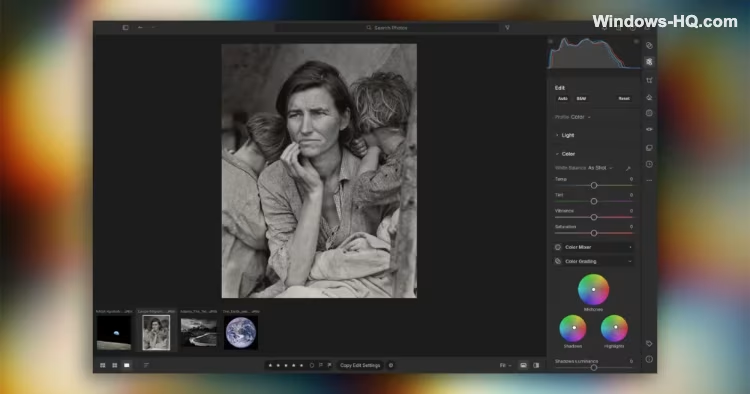
The suite includes seven applications that mirror Adobe’s core products: PhotoCraft for Photoshop, VectorCraft for Illustrator, FilmCraft for Premiere Pro, LightCraft for Lightroom (not Classic), PrintCraft for Acrobat, EffectCraft for After Effects, and DesignCraft for InDesign. All seven are written in pure Rust and are dual-licensed under MIT and Apache 2.0, meaning anyone can download, modify, and redistribute them for free. The apps are available for macOS, Windows, and Linux, the latter of which Adobe does not support at all. Six of the seven can also be compiled to WebAssembly and run directly in a browser tab, and none use Electron or embedded web shells.
The project’s technical approach is defined by what Thomas calls a “clean-room reimplementation” of Adobe’s apps. Working guidelines for AI agents in the VectorCraft repository explicitly forbid reading, decompiling, or copying anything from Adobe’s installation files, and prohibit the use of Adobe icons, images, presets, color swatches, and brushes. Behavioural specifications are sourced only from public documentation and from observing Adobe software in use with self-made test files, and even copying open-source code licensed under GPL/AGPL is forbidden. The most mature app, PhotoCraft, is labelled “early alpha” but already supports layers, masks, adjustment layers, text, brushes, and the ability to read and write real PSD and PSB files while preserving layers. According to ArtCraft, PhotoCraft achieved a round trip of 134 out of 135 test files where content remained unchanged after loading and saving, and it supports RGB, CMYK, Lab, grayscale, and 8-, 16-, and 32-bit documents with ICC color management.
At the time of writing, the apps are at varying stages of development. PhotoCraft and PrintCraft are positioned as “early alpha,” while VectorCraft, FilmCraft, LightCraft, EffectCraft, and DesignCraft are listed as “in development”. Thomas has stated that he hopes to reach “100% feature parity” with Adobe’s software “within a month,” an ambitious target even with AI code-building tools. However, the PetaPixel article notes that “100% feature parity” is not necessarily 100% functionality parity or performance parity, and that professional environments where pixel perfection, color accuracy, calibration, compatibility, and support matter a great deal leave significantly less room for experimentation.
The project has generated intense interest and equally intense debate. The Photoshop-like PhotoCraft accumulated more than 5,700 GitHub stars within a week, and nearly all of the other six projects surpassed 1,000 stars. Many people are excited about the prospect of free alternatives to Adobe’s pricey Creative Cloud software, given the company’s established monopoly in the creative software space. However, reactions have been mixed. Some commenters accuse the developer of stealing from Adobe and warn of a lawsuit, while others defend the project as a clean-room reimplementation and argue that Adobe deserves the competition due to its business practices.
The most serious concerns raised by skeptics centre on the safety and reliability of AI-generated code. A single developer has generated potentially hundreds of thousands of lines of code for multiple pieces of software very quickly, and verifying that code becomes a monumental task without a team. A 2026 State of Code Developer Survey of 1,100 professionals by Sonar indicated that 96% of developers do not fully trust AI-generated code, and privacy problems, malicious code, and unsafe file handling are among the listed concerns. One commenter sarcastically described the project as “Piracy,” while others dismissed it as “vibecoded AI slop,” though excited testers say it could be a legitimate Adobe alternative.
The project also raises unresolved legal questions. The PetaPixel article notes that while legal precedent protects functionally identical software provided it does not infringe protected designs or technologies, it is possible to patent the design of an app or the specific way in which a software tool works, and Adobe holds thousands of patents. The article observes that this legal framework was developed when reverse engineering software was so cost-intensive and time-consuming that undocumented code was itself a form of financial security, and that with the advent of AI, that is no longer the case. How this will affect the broader software industry remains to be seen.
ArtCraft’s business model is notable: the software itself is free and can be used without a subscription, but there are optional subscriptions with generative AI credits for using various AI tools inside the apps, and users can also bring their own compute and third-party subscriptions for AI generations. The core ArtCraft platform supports numerous generative AI models, including Nano Banana, GPT Image, FLUX, Seedream, Seedance, Kling, Veo, and Sora. The developer has also made the software “agent-native,” allowing AI to use the tools and menus over a JSON control channel and an MCP server, essentially intending for users to let AI create art directly using the software.
PetaPixel has reached out to Adobe for comment on ArtCraft, and the publication notes that the story will be updated if the company responds. For now, ArtCraft remains an ambitious and controversial experiment that tests the limits of what AI-assisted development can achieve, the boundaries of clean-room reverse engineering, and the appetite among creative professionals for a free, open-source alternative to the software that has dominated their industry for decades. Thomas has promised that the project is not “just some one-off flash in the pan that will die,” but whether ArtCraft can deliver on its grand promises—and withstand the legal and technical scrutiny that will inevitably follow—remains an open question.
Open-Source ArtCraft Challenges Adobe with AI-Built Creative Suite
A new open-source suite, ArtCraft, has been built in Rust using advanced AI models to mimic Adobe's popular creative applications. Founded by Brandon Thomas, the suite offers free, open-source alternatives for macOS, Windows, and Linux.