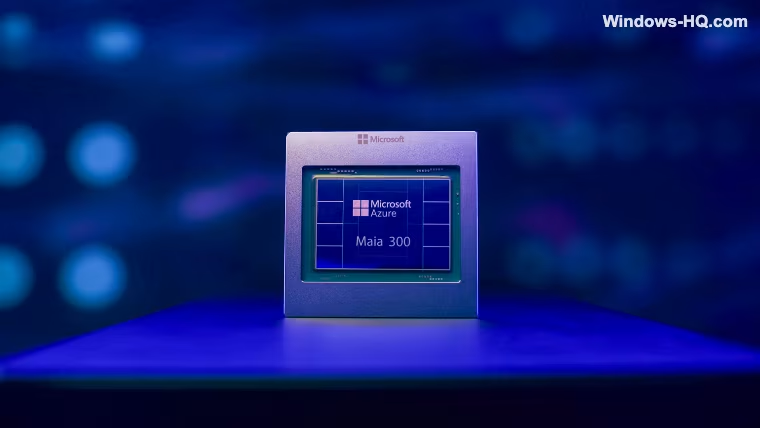
Microsoft announced the Maia 300, its third-generation in-house AI chip. The hardware is designed to become the primary AI inference system powering the company’s various products and services.
This development marks a strategic effort to reduce Microsoft’s dependence on third-party GPUs from Nvidia and AMD. The company plans to scale the Azure Maia family to multi-gigawatt deployments starting in 2027.
The Maia 300 emphasizes efficiency. According to Scott Guthrie, executive vice president of Microsoft’s cloud group, the chip is expected to deliver 40 percent more tokens per megawatt compared to current leading GPU-based systems.
When configured with 96 accelerators per rack, the chip delivers up to 7 times the rack-scale token throughput of its direct predecessor, the Maia 200.
The chip is optimized for new, complex AI workloads. These tasks include sustained, multi-step agentic processes, long-context reasoning, and latency-sensitive conversational experiences.
The Maia 300 is also a successor to the Maia 200, which was announced in January. The Maia 200 is currently running on production AI workloads across Microsoft, supporting services like GitHub Copilot and Microsoft Copilot.
Microsoft is achieving these efficiency gains using a new chiplet architecture. Additional technical specifications detail the chip’s components. The Maia 300 features eight HBM4 memory stacks, providing 18 terabytes per second of memory bandwidth. Its thermal design power stands at 950 watts.
A full rack configuration houses 96 chips and consumes approximately 167 kilowatts of power. The core computing processor of the chip is composed of chiplets and utilizes partly TSMC’s 2-nanometer process.
The rollout of the Maia 300 to production AI workloads is scheduled to commence in 2027. This timeline aligns with Microsoft’s broader goal of expanding its Maia infrastructure to multi-gigawatt capacity during the same year.
This rollout positions the chip as central to Microsoft’s long-term AI infrastructure strategy. The goal remains improving the efficiency and lowering the cost of running AI workloads in the cloud.