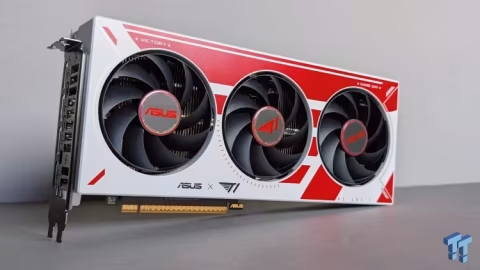
The ASUS T1 GeForce RTX 5070 OC Edition is a limited-edition graphics card developed in collaboration with T1, the South Korean esports team known for its dominance in League of Legends. The card received an overall score of 90% from TweakTown.
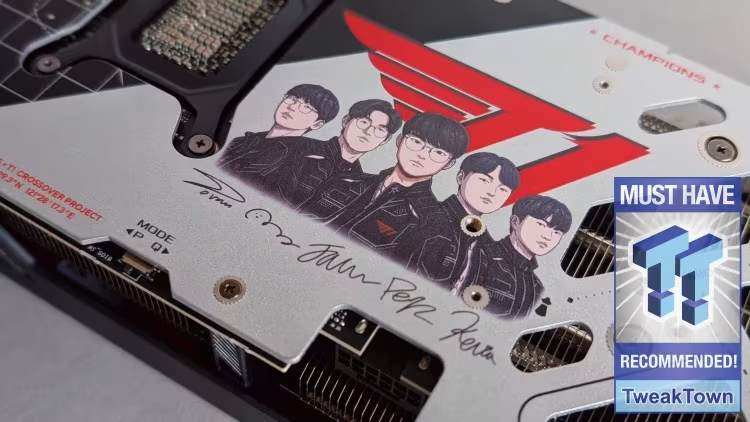
Unlike other branded cards, the reviewer noted that this model was designed alongside T1, featuring a high-contrast black, white, and grey aesthetic. The artwork celebrates the team’s players and their World Championship victories in 2023, 2024, and 2025.
As a dedicated collector’s item for T1 fans, the GPU also presents solid performance metrics. The card ships with a boost clock of 2595MHz in Turbo mode, exceeding the 2512MHz reference specification.
Specifications include 12GB of GDDR7 memory on a 192-bit interface. This setup delivers 672 GB/sec of bandwidth, representing a 33% increase over the RTX 4070’s GDDR6X memory. Power is managed via a single 16-pin PCIe connector, with an included adapter for two 8-pin connectors, and the total graphics power is rated at 250W.
In terms of connectivity, the card measures 305 x 126 x 50mm and provides three DisplayPort 2.1b outputs and one HDMI 2.1b port. It supports up to 4K at 480Hz or 8K at 165Hz.
While the RTX 5070 has fewer CUDA, Tensor, and RT cores than the RTX 4070 SUPER, the Blackwell architecture allows it to outperform both the 4070 and the 4070 SUPER. The ASUS T1 OC Edition achieved 1440p performance 30% faster than the RTX 4070 on average. It also outperformed the RTX 5070 Founders Edition by 4.3% at that resolution.
The card performs exceptionally well in competitive titles. Counter-Strike 2 exceeded 300 FPS, and League of Legends maintained frame rates between 550 and 600 FPS, even when running at 4K.
However, performance drops at 4K resolution. Average frame rates fell from 120 FPS at 1440p down to 68 FPS. In ray-traced titles, the 12GB of VRAM began to show strain with high-quality textures.
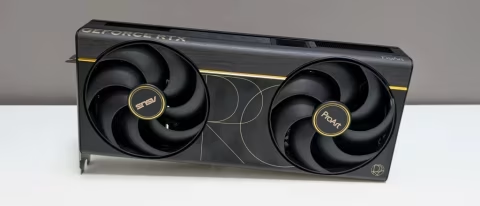
For 1440p use, the ASUS T1 is described as a powerhouse. It remains a capable card, though it trails the Radeon RX 9070 and falls short of the RTX 5070 Ti and the RX 9070 XT. The card’s thermal design was highlighted as a key strength. The custom solution maintained cool and quiet operation at 1440p, even during extended stress testing, due to low fan speeds.
DLSS 4.5 was identified as a key performance booster. The new Transformer model for Super Resolution and Ray Reconstruction delivered substantial gains. At 1440p, the card’s native rendering average of 120 FPS jumped to 140 FPS using the DLSS Quality preset.
Multi Frame Generation makes extreme scenarios possible. For example, running Cyberpunk 2077 at 1440p with RT Ultra settings reached frame rates between 130 to 230 FPS. The review cautioned, however, that using this technology in competitive games where latency matters is discouraged.
Meanwhile, the performance cost of DLSS 5, or 3D-Guided Neural Rendering, was reviewed. Enabling this technology in NBA 2K27 at 1440p caused a frame rate drop from 224 FPS to 69 FPS—a 70% performance reduction. While DLSS 5 provides visual improvements, its performance cost is considered prohibitively high for general use.
Overall, the ASUS T1 Edition is presented as a well-executed piece that marries a meaningful aesthetic collaboration with solid 1440p performance and excellent thermal management. For fans of the team, the card offers value beyond its specifications, while mainstream gamers should note that the Radeon RX 9070 XT and the RTX 5070 Ti offer arguably stronger alternatives for those with higher budgets.