The Asus ProArt GeForce RTX 5090 32GB GDDR7 OC Edition is a specialized GPU aimed at creators, AI users, and compact workstation builders seeking full RTX 5090 performance without the bulk of traditional flagship coolers.
This model features the standard RTX 5090 specification, including 21,760 CUDA cores and 32GB of 28Gbps GDDR7 memory on a 512-bit bus with PCIe 5.0 support. It includes a mild factory overclock, boosting the clock to 2512MHz in OC mode compared to the stock card’s 2410MHz, and requires a recommended 1000W power supply.
The pricing for this card is approximately $4,099/£3,799/AU$6,499, placing it at the premium tier for an RTX 5090. The reviewer noted that the extra cost primarily supports the compact ProArt design rather than providing a meaningful performance uplift.
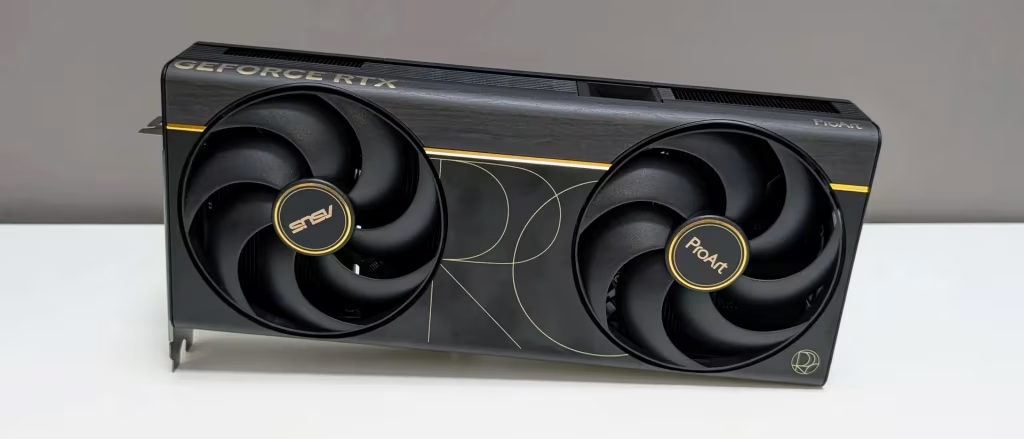
A key feature of the card is its slim footprint, measuring 304 x 140 x 50mm and being SFF-ready. This design is significantly slimmer than most flagship RTX 5090 cards, allowing ample space for other expansion cards, side-panel clearance, and cable routing in compact builds.
Installation was straightforward, aided by included accessories such as a 1-to-4 power adapter, a rear-angled 16-pin connector for easier cable management, and an adjustable GPU support bracket to prevent sag. The build quality was rated as top-notch, with no flex.
Aesthetic design focused on a creator/workstation look rather than traditional RGB, featuring brown wood-patterned laminate trim and subtle gold ProArt branding.
Cooling is managed by two large Axial-tech fans, a vapour chamber, liquid metal on the GPU die, and a double-vented backplate. The card features a dual-BIOS switch allowing users to select between Performance and Quiet modes.
Performance testing showed differences between modes: in OC mode, the GPU peaked at 76°C and memory reached 86°C. While running warmer than larger 5090 cards with bigger coolers (which typically run about 10°C cooler), fan noise peaked at 36dB, comparable to far larger coolers.
In standard mode, the card ran approximately 5% cooler and 6% quieter with minimal performance loss. The Quiet mode offered further improvements, running about 7% cooler and 6% quieter, though it resulted in a loss of roughly 2% of performance.
On raw performance, OC mode delivered about 3% faster performance than a stock RTX 5090. This advantage widened significantly against older or lower-tier hardware, running approximately 45-50% ahead of the RTX 5080 in compute workloads and roughly 40% ahead of the RTX 4090.
The combination of 32GB of faster GDDR7 memory and the Blackwell architecture provided a clear edge for rendering and AI workloads, particularly where smaller cards would run out of VRAM.
Gaming performance was also excellent. Tests included Cyberpunk 2077 at 4K with Ultra Ray Tracing and balanced upscaling, achieving 98fps. Black Myth: Wukong reached 88fps at 4K with ray tracing and 50% upscaling enabled.
The overall assessment is that this card is a capable, specialized RTX 5090 for compact high-end builds. However, the high price and the presence of coil whine under heavy load remain noted issues. Buyers prioritizing the slimmer form factor, USB-C display output, and creator aesthetic will find value here, while those seeking the best value performance might opt for cheaper alternatives or larger AIO-cooled cards if noise and temperature are primary concerns.