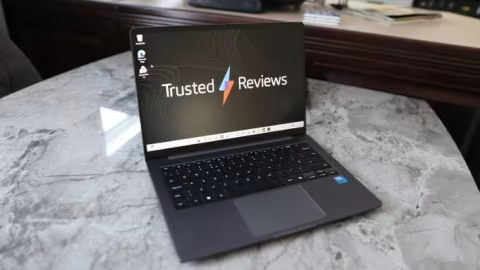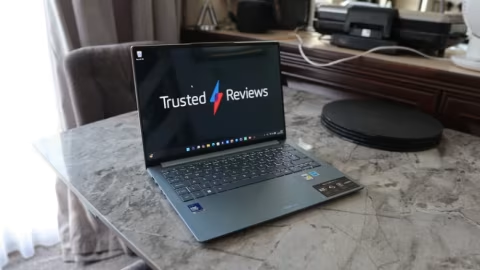
The Asus ProArt P16 (2026, RTX Spark) arrives as a premium creator laptop, representing one of the first machines to integrate Nvidia’s RTX Spark system-on-chip. Trusted Reviews noted the device as an impressive debut for the new platform.
At a starting price of £3,899.99 / $4,399.99, the reviewed unit pairs a 20-core Grace CPU, co-developed with MediaTek, with an integrated RTX Blackwell GPU. This setup includes 6,144 CUDA cores, 64GB of unified memory, and a 1TB PCIe Gen 4 SSD.
The shift to an SoC architecture allowed Asus to significantly streamline the design. The ProArt P16 measures just 12.9mm thick and 1.77kg, making it the thinnest 16-inch ProArt the company has created while retaining its machined aluminium chassis.
Despite its compact profile, the port selection is extensive for a professional-grade machine. Connectivity includes two 40Gbps USB4 Type-C ports, a full-size HDMI port, a 3.5mm headphone jack, an SD card reader, and a separate USB-A port.
The display unit itself is a 16-inch 3K (2880×1800) Lumina Pro tandem OLED screen with a 120Hz refresh rate. While peak SDR brightness is 436.5 nits, it achieves up to 1,100 nits in HDR content. Colour accuracy remains a strong point, supporting perfect 100% sRGB and DCI-P3 coverage.
Performance measurements demonstrate the power of the integrated components. In Geekbench 6, the ProArt P16 scored 3,085 single-core and 19,313 multi-core, surpassing rivals like Intel’s Core Ultra X9 388H. More impressively, the integrated GPU clocked a 3DMark Time Spy score of 11,763, a figure in line with some discrete RTX 5070 laptops.
Local AI capabilities form a central pillar of the laptop’s pitch. The ProArt P16 handles 8-billion-parameter models smoothly. Running Llama 3.1 8B averages 54.3 tokens per second on Windows ML. The laptop is designated a Copilot+ PC, featuring built-in generative capabilities across the operating system.
Battery life distinguishes the machine. A 99.9Whr cell delivered 13 hours and 55 minutes during a 1080p video loop test at 150 nits, exceeding the 10-hour target. The charger, rated at 140W, replenishes the power cell to 50% in 30 minutes.
Compared to its direct predecessor, the RTX Spark model trades some raw gaming performance for superior portability and battery endurance. The reviewer suggests these gains in form factor and longevity may be beneficial for most creative professionals. However, buyers who prioritize maximum raw performance over slimness or local AI features might consider discrete-GPU laptops.