The Epomaker HE75 V2 TMR is a 75% wireless mechanical keyboard that reviewers assessed with a 7.0/10 score. Rated for its array of features, the keyboard is positioned as a strong choice for users seeking comprehensive functionality at a $129 USD price point.
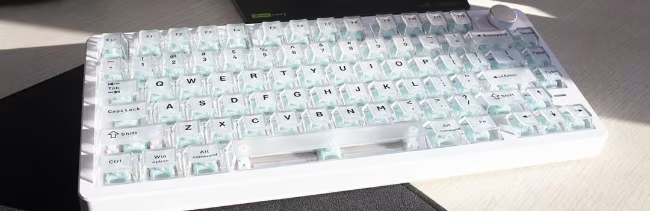
The board maintains a 75% ANSI QWERTY layout, incorporating 80 keys and a removable rotary knob that can be substituted with two extra keys. Physically, the HE75 V2 is constructed from ABS plastic and is available in black or white. The design features minimal branding, limited only to a top-left corner mark and a rear label. Dimensions measure 324mm × 138mm × 43mm, and the unit weighs 980g without the included cable.
Keycap materials are polycarbonate (PC) plastic, featuring silk-printed legends. The review advises that this printing method is cheaper but will wear more easily over time compared to double-shot or dye-sublimation options. The caps measure approximately 1.5mm thick, which contributes to a deeper sound profile. Furthermore, secondary functions on the F-row and arrow keys require reference to the manual, as they are not printed on the keycaps.
Underneath the keycaps reside Epomaker’s Creamy Jade magnetic switches. These switches utilize TMR (Tunnel Magnetoresistance) technology, detecting changes in electrical resistance rather than measuring voltage from a moving magnetic field. They are linear, pre-lubricated, and feature a 3.5mm travel distance. The switch assembly is hot-swappable, offering support for both standard 3/5-pin switches and magnetic types, providing significant flexibility.
The keyboard’s acoustics are managed by a complex five-layer sound-optimizing system. This assembly includes sandwich latex foam, a switch pad, a PET sound-enhancement pad, noise-absorbing foam, and bottom silicone. This dedication to dampening material aids in producing a deep, muted “clack” sound. The plate used in the build is FR4.
Connectivity is offered in a tri-mode format: 2.4GHz wireless, Bluetooth, and wired USB. The wired and 2.4GHz connections support an 8000Hz polling rate, while the Bluetooth connection operates at 125Hz. Powering the device is a large 8000mAh battery cell. The system also supports full N-key rollover for simultaneous key presses.
Software management is provided by Epomaker Driver 4.0. This program allows users to control key remapping, macros, and lighting, alongside the magnetic-specific settings, including Rapid Trigger. Right Shift can toggle Rapid Trigger on and off, a useful feature cited because leaving it active can otherwise cause misinputs.
While the construction of the ABS plastic case is described as good, the review points out certain compromises. Expected flex is present from both the plastic case and the gasket mount. Additionally, the physical process of disassembly is noted as quite difficult. The top and bottom frames are held by tight clips, and the reviewer warns against forcing the opening to avoid cracking a frame.
The overall assessment praises the keyboard’s comprehensive feature set. The inclusion of the hot-swap flexibility, the large battery, and the high polling rate are cited as major positives. However, potential buyers should be aware of the wear susceptibility of the silk-printed legends and the absence of web driver support for the model.