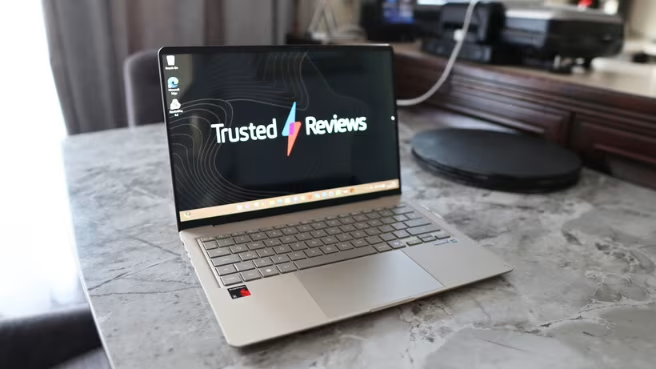
The Asus Zenbook 14 (2026) presents itself as a highly portable and stylish Windows ultrabook. It maintains a recognizable look and feel, appearing similar to last year’s Zenbook A14 (2025). The machine features a Ceraluminum chassis, giving it a beige colorway that the review notes is unique among lightweight ultrabooks.
The chassis measures 1.1kg, a slight increase of 100g compared to the older model, yet it remains highly portable for a compact laptop. The device also offers a solid selection of ports, and the keyboard and huge trackpad contribute to a satisfying overall experience.
Display quality is achieved through a compact 14-inch 1920×1200 60Hz OLED screen. While this panel delivers deep blacks and excellent contrast—with measurements of 0.01 for black level and 10210:1 contrast—the review highlights the limitation of the 60Hz refresh rate and the smaller resolution for its size.
Performance is dictated by the base model Snapdragon X chip, which powers the Zenbook 14 (2026). Qualcomm used this first-generation chip to compete in the lower-cost laptop sector, an intentional move that prevents the incorporation of newer chips like the X Plus or X Elite. Consequently, the performance is described as fine, if underwhelming when compared to more recent 2026 processors.
Battery endurance remains strong. Testing showed the laptop lasted for 13 hours and 32 minutes in the PCMark 10 Modern Office test, allowing for roughly two working days away from an outlet. The internal battery capacity is 50Whr, although Asus quotes up to 30 hours of runtime on charge.
The device does not include its own charger. Using a high-wattage Ugreen option, the laptop pulled up to 66W when charging from the wall. It took 28 minutes to reach 50% charge and 78 minutes for a full charge.
Pricing places the Zenbook 14 (2026) at £1199.99. The report points out that this cost is higher than the previous model and approaches the pricing of more powerful rivals.
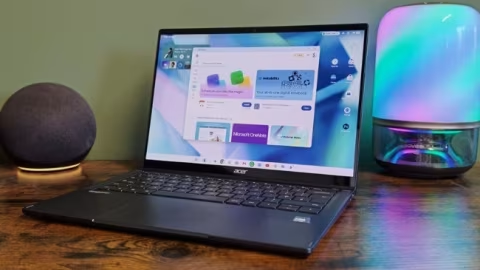
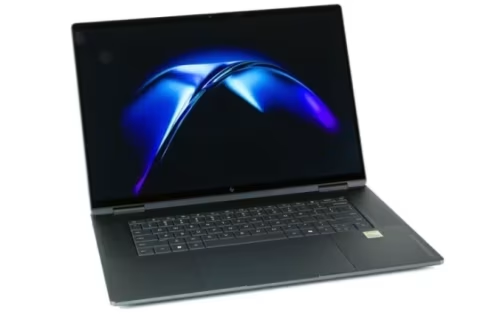
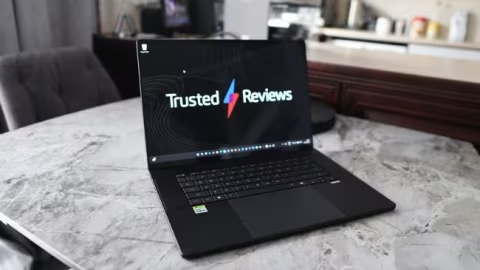
Other competing models reviewed include the Dell XPS 14 (2026) base model, the Acer Swift Spin 14 AI (2026), and the Acer Swift Go 14 AI (2026). For those needing more power, the Snapdragon X chip inside the Zenbook 14 (2026) may prove insufficient. However, the reviewer points to the Asus Zenbook A14 (2026) as a direct alternative, which offers the same chassis but includes a more powerful Snapdragon X2 Elite chip and wider port selection at a comparable price point.
Journalists note that the Acer Swift Spin 14 AI (2026) is more expensive, but offers the 12-core Snapdragon X2 Elite SoC, a 120Hz touchscreen, and stronger battery life. Meanwhile, the Acer Swift Go 14 AI (2026) provides stronger performance and comparable port selection for less money. Furthermore, the Dell XPS 14 (2026) base model offers a sharper redesign and similar battery longevity, alongside the option of switching platforms to the Apple MacBook Neo for a significantly lower price point.