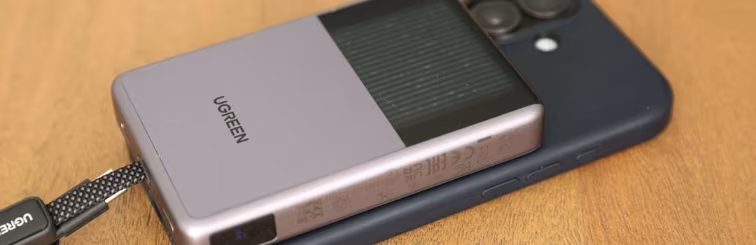
The UGREEN MagFlow Pro is a 10,000mAh portable charger that incorporates a unique liquid-cooled system, positioning itself as a feature-rich solution for mobile power needs. The device measures 10.85cm deep, 7.06cm wide, and 1.63cm thick, weighing 230g, and is housed in a gray rectangular enclosure with rounded corners. Its construction combines a plastic body with metal sides, giving it a solid feel.
A prominent design feature is the liquid cooling system, which is visible through a dedicated screen on the front of the unit. UGREEN claims this cooling mechanism maintains the power bank 10°C cooler than standard chargers while consuming minimal power (0.02W). Activating the coolant pump is done via a single button; the process generates an audible buzzing noise.
Internally, the MagFlow Pro contains two 5000mAh lithium-ion batteries manufactured by ATL (Amperex Technology Limited). These batteries, rated at 3.92V each, total 39.2Wh. This capacity falls under the 100Wh airline carry-on limit, making the unit suitable for air travel.
In terms of connectivity, the charger features a built-in 45W USB Type-C cable that includes a braided design and a strap loop. This cable is not removable. Separately, the unit includes a dedicated USB Type-C port and a Qi2.2 25W wireless charging pad on the back. The wireless pad utilizes seventeen N52H magnets, delivering 8N of gripping force for MagSafe-compatible devices.
Testing revealed the performance of the charger across three main functions. Charging the power bank itself from 20% to 80% took 1 hour and 20 minutes, recovering 60% of its capacity. The average charge rate during this process was 16.65W.
For charging a phone via the built-in USB Type-C cable, the process from 20% to 80% took 36 minutes. This connection maintained a peak output of 26.2W, with an average rate of 14.8W.
Wireless charging via the Qi2 standard proved slower. Charging the same phone, equipped with an OEM Apple silicone case, from 20% to 80% required 52 minutes. The average charge rate in this scenario was 9.93W.
Reviewing the efficiency, the power bank’s own charge status dropped by 24% (9.41Wh) when charging the phone via Type-C, achieving a 91.5% charging efficiency. Conversely, charging via Qi2 caused a reduction of 39% (15.29Wh) in the power bank’s charge status, resulting in a 56.3% efficiency. The results showed performance aligned with the stated specifications.
The report highlighted several operational advantages. Users appreciate the solid build, the dedicated USB-C port, and the convenience of the integrated braided cable and MagSafe compatibility. The ATL batteries and the liquid-cooled circuitry are noted quality components.
However, the review also identified limitations. Self-charging capacity maxes out at around 30W, meaning faster self-recharging would improve the device. Furthermore, when attached to a standard-size iPhone, the unit sticks out slightly at the bottom. Finally, the coolant pump generates a noticeable buzzing sound in quiet environments, which may prove bothersome to some users. Despite these drawbacks, the overall package and feature density justify the price point for a 10,000mAh unit.