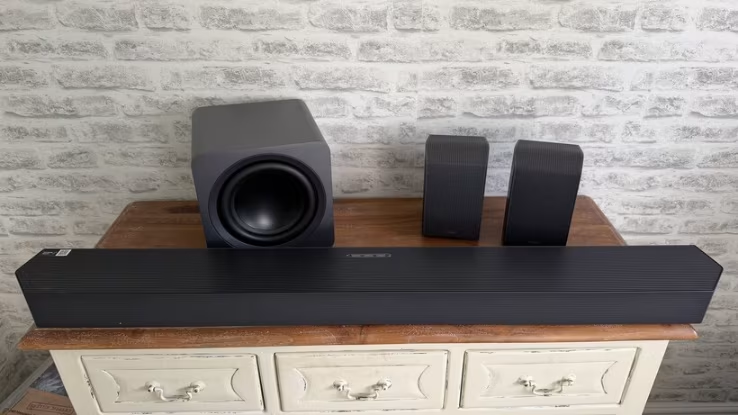
Samsung has launched the HW-Q990H, its flagship 11.1.4-channel soundbar system for 2026. Priced at £1,449, the comprehensive system is designed to deliver full surround sound, consisting of a main soundbar, two rear speakers, and a compact dual-driver subwoofer.
The system maintains the aesthetic of industrial sculpting, featuring four distinct components. The main bar sports a hard black plastic finish with angular sculpting and double-angled ends. The rear speakers and subwoofer add further angular style, contributing to a cohesive look despite accommodating four separate units.
The core appeal of the Q990H remains its 11.1.4-channel count. This configuration is designed to create a seamless hemisphere of sound around the viewer, supporting full Dolby Atmos and DTS:X playback. Beyond these standards, the system features an impressive real-time up-mixing option that can convert basic stereo mixes into a multi-channel experience, utilizing all available channels.
Optimization and ease of use are managed by several built-in systems. SpaceFit Sound Pro auto-calibration continually monitors the sound environment, while an AI bass management system monitors the 300W subwoofer input, preventing distortions and ensuring consistent low-end output. The main soundbar includes an LED display that provides instant user information regarding sound format, input, and volume.
Control is streamlined through supporting apps. Users can utilize the Samsung Sound and Samsung SmartThings applications to control the soundbar via a visual interface and integrate extra speakers for multi-room setups. Specific listening modes include a personal mode, which plays sound exclusively through the rear speakers, and a party sound grouping mode that syncs the rear and front speakers for unified music playback.
The hardware supports several advanced features. An AI Adaptive mode automatically adjusts playback characteristics based on the source material, whether it is sports footage, a movie, or news. For cinematic accuracy, a dedicated Game Pro mode emphasizes sound directionality, aiding users in placing the approaching source. Furthermore, the Active Voice Amplifier increases dialogue volume when ambient noise is detected. A new Sound Elevation system physically lifts the perceived height of the sound, compensating if the TV or screen is positioned unusually high.
Connectivity is one of the system’s strongest points. The Q990H features a two-in, one-out HDMI pass-through, which supports Dolby Vision and HDR10+ HDR signals alongside 4K/120Hz video. This capability allows consoles or PCs to connect directly to the soundbar while passing the video signal to the TV, a feature useful for mitigating issues like dropouts or audio delay often associated with eARC systems.
The soundbar also supports both eARC HDMI and an optical digital audio input for non-Atmos/DTS:X sources. Wireless connectivity is provided via Bluetooth and Wi-Fi, integrating support for Spotify Connect, Tidal Connect, Apple AirPlay, Alexa, and Google Cast. Samsung’s Q Symphony feature allows the soundbar to share speaker duties with compatible Samsung TVs rather than merely taking over from the TV’s built-in audio.
In terms of performance, the Q990H successfully creates a near-flawless hemisphere of sound. The up-firing channels in both the front and back speakers integrate perfectly to form the Dolby Atmos sound dome. Side-to-side transitions sound seamless, while the rear speakers match the tonal quality of the main bar, preventing the sense of sound funnelling. The system maintains huge power and precision, ensuring that impact sounds, such as explosions or gunfire, hit with visceral intensity while dialogue remains crisp and clear.
The subwoofer delivers exceptionally deep bass, rolling out with smoothness and intensity. This low-frequency contribution remains consistent even during heavy movie mixes. In pure stereo operation, the sound maintains a refined sense of separation and coherence, delivering excellent vocal positioning and warmth.
While the review noted that the HW-Q990H does not fundamentally alter the hardware from its predecessor, it delivers a clearer sense of height with overhead effects. It also features a noticeably smoother and cleaner bass rollout compared to the Q990F, which adapts better when used with music. The primary minor criticisms noted include occasional clipping of vocals and excessive crispness on hard-edged musical hits, especially when the Surround up-mix option is used for stereo music.