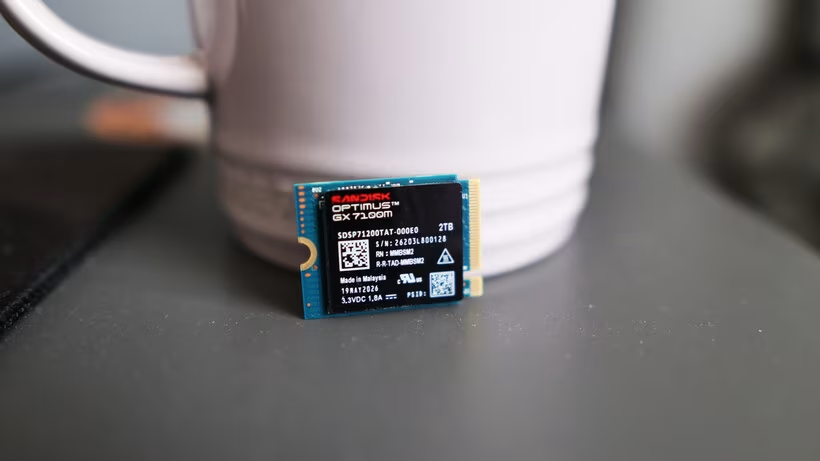
The SanDisk Optimus GX7100M is introduced as a new small form factor PCIe 4.0 SSD, marking the first SanDisk-branded entry into drives designed for gaming handhelds. It serves as a direct successor to the WD_Black SN770M after SanDisk assumed control of the former WD gaming SSD division.
The drive utilizes the M.2 2230 form factor, making it suitable for devices like the Steam Deck or Asus ROG Ally, though it can also be installed in compatible standard desktop motherboards. Due to size restrictions inherent to these smaller drives, maximum storage capacity is limited to 2TB.
Technically, the Optimus GX7100M features an in-house SanDisk controller and employs TLC NAND memory. It does not include a DRAM cache but instead utilizes Host Memory Buffer (HMB) technology, which leverages system RAM for caching purposes. SanDisk provides a five-year warranty, with endurance ratings of 600TBW for the 1TB model and 1200TBW for the 2TB variant.
The physical unit is compact, measuring 22 x 30 x 2.3 mm and weighing only 2.3 grams. The review sample, a 2TB version, carries an estimated UK RRP of £402.99 and a US RRP of $449.99.
Performance testing was conducted using a system featuring an AMD Ryzen 7 7800X3D CPU and an Nvidia RTX 4080 Super GPU, covering both synthetic benchmarks such as CrystalDiskMark 8, and real-world applications like file transfers and game loading times.
In the CrystalDiskMark 8 tests, the Optimus GX7100M recorded sequential read speeds of 7367.03 MB/s and write speeds of 6971.36 MB/s. These results surpass SanDisk’s quoted performance figures of 7250 MB/s and 6950 MB/s, placing it ahead of the older WD_Black SN770M and slightly faster than the full-size WD Black SN7100.
Despite its strong sequential metrics, the drive performed slower than its rivals in random 4K performance tests. Furthermore, results in the PCMark 10 Data Drive and Quick System Drive benchmarks were noted to be more typical of value-oriented drives.
In practical use, a 120GB file transfer was completed in 40.5 seconds, achieving an average transfer rate of 2.96GB/s, which the review characterized as strong for its category. A test utilizing Final Fantasy XIV Endwalker reported a load time of 7.86 seconds, faster than the SN770M and marginally quicker than the SN7100.
Overall, while the drive excels in sequential speed, its random performance is less robust compared to competitors. Although it is not as fast as PCIe Gen 5 drives, it effectively maximizes the potential of the PCIe Gen 4 standard. Key limitations noted include average durability and a high retail price tag.
The review concluded that for users seeking a small, fast SSD, the Optimus GX7100M is excellent for gaming handhelds. However, for general PC or PS5 use, comparable M.2 2280 drives may offer similar performance at a lower cost. The high price was attributed to the current memory crisis rather than SanDisk’s pricing strategy.