The D-Link F518 5G Wi-Fi 6 AX1800 is a portable mobile router designed with battery life as its primary focus. It utilizes an 8000mAh cell, providing the capacity to run through a full working day.
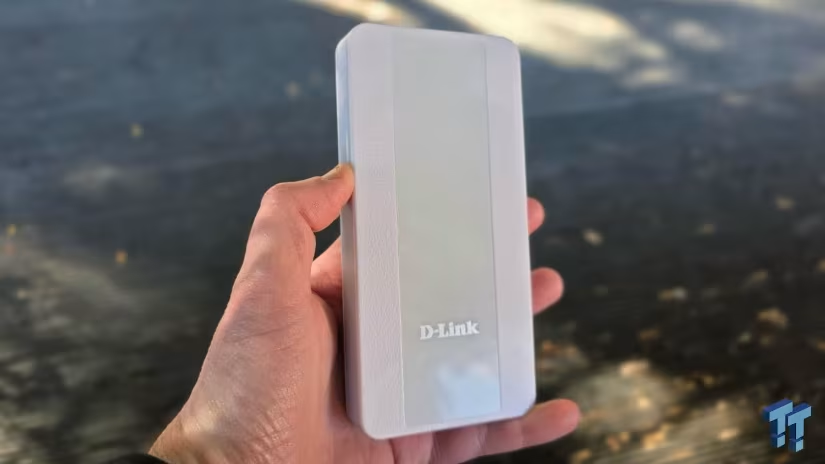
The device’s form factor resembles a large power bank, measuring 147x72x15mm and weighing 274 grams, leading some to note that it is bulky rather than truly pocketable. Despite this, its USB-C port allows it to be used for charging other devices.
A key physical characteristic is the absence of a display screen. Instead, setup relies on simple connection lights and includes default Wi-Fi credentials printed on a sticker on the back. Operation requires engaging two side buttons: one for power and another for WPS connectivity. The unit also features a single Nano-SIM card tray located on the left side.
The initial setup process is described as straightforward: users must insert a Nano SIM card, press the power button, and wait for indicator lights to confirm an established connection. System configuration is managed entirely through a web interface, which provides access to various settings.
The web interface allows management of basic network status data, data throughput rates, battery status, connected devices, mobile provider parameters, and detailed Wi-Fi configuration options. Advanced features available within the web portal include bandwidth settings and MAC filters. Additionally, the device supports SMS messaging, though this feature is noted as having limited practical use.
In terms of connectivity specifications, the F518 supports 4G+ LTE and 5G NR. Its theoretical Wi-Fi speeds are rated up to 1800Mbps (composed of 574 + 1200Mbps), while mobile data speeds can reach up to 2.6Gbps when utilizing 5 GHz sub-6 GHz bands.
Real-world testing using a Telstra SIM in Sydney provided differing results from the theoretical claims. Typical down speeds were observed ranging from approximately 50Mbps at worst, peaking no higher than 450Mbps at best when connected to a Google Pixel 10 Pro Fold.
However, the device excelled in its Wi-Fi range, performing better than anticipated by working effectively even in larger rooms and passing through several smaller walls in an office setting. Battery life remains the unit’s standout feature; the 8000mAh rating is specified for up to 16 hours of operation.
During real-world testing involving a MacBook Air M2 and a Google Pixel 10 Pro Fold over a standard nine-to-five workday, the battery level dropped only to 22% by day’s end. While indicator lights are present, their utility is questioned, as they remain solid green across a wide capacity range (99% down to 20%), only changing color at lower percentages.
The reviewer highlighted several benefits, including all-day battery usage for multiple devices and an easy setup process requiring minimal configuration. Performance merits also include the theoretical high speeds and surprisingly robust Wi-Fi range. Conversely, drawbacks noted were the device’s bulky size, the tendency to generate heat under sustained load, the limited usefulness of the indicator lights, and the lack of eSIM support.
The absence of a physical display screen forces users to utilize a web interface for checking metrics, which one reviewer found tedious. Despite these limitations, the D-Link F518 is deemed a viable option for users needing simple, sustained mobile broadband data sharing, particularly in professional or business settings where keeping connected devices charged is critical.
The overall review assigned the D-Link F518 an aggregate rating of 78%, with individual sub-scores confirming strong performance (85%) and solid quality (80%).