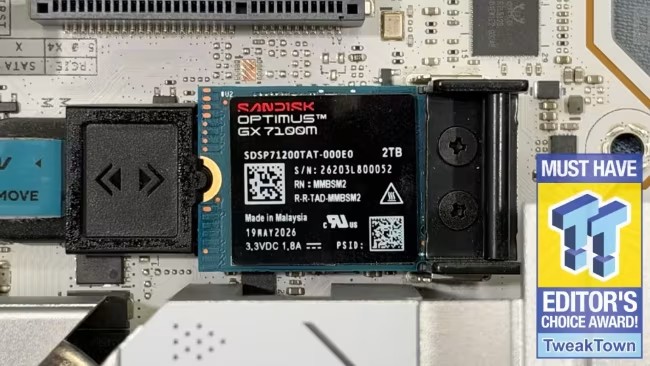
TweakTown recently reviewed the SanDisk Optimus GX 7100M 2TB drive, publishing the piece on 13 November 2026. The outlet framed the drive as its “New Favorite at 2230,” claiming it is the best choice for users needing a PCIe Gen4 SSD in the 22x30mm form factor, specifically for handhelds, PS5 consoles, or thin laptops.
Their primary justification centered on price relative to flash quality. TweakTown highlighted the cost structure, describing the performance at roughly 20 cents per megabyte and labeling it as TLC flash at QLC money. This pricing strategy, the review argued, is a significant advantage since most 2230 alternatives use QLC flash or are difficult to source.
However, independent reviews from sources like Tom’s Hardware and The SSD Review provide a more nuanced picture. The specification of the GX 7100M remains top-tier for its segment. Both the 1TB and 2TB models are rated for sequential read speeds up to 7,250 MB/s and write speeds up to 6,900 MB/s. Random performance is also high, delivering 1,000K read and 1,300K write IOPS.
The drive achieves its 2TB capacity using a single-sided NAND package, a technical feat given the historically constrained 2230 form factor. Furthermore, Tom’s Hardware pointed out that its strength lies in random read performance, the metric most critical for responsiveness and game loading.
Power efficiency emerged as the single most compelling point. Despite operating near the limits of the Gen4 interface, Tom’s Hardware measured the drive at under 4W under typical workloads, calling it the most power-efficient M.2 2230 SSD it had tested. For devices like the Steam Deck or a thin laptop, this efficiency translates directly to reduced heat and extended battery life.
System-level performance metrics, however, are less impressive. The SSD Review placed the drive in the bottom third of its PCMark 10 Full System Storage results (4,546) and the Quick System Drive test (5,357). Another test noted an 8.73-second load time for Final Fantasy XIV, which the outlet stated was “not a good return.”
Another consideration is thermal management. Tom’s Hardware recorded peak sensor temperatures ranging from 73°C to 85°C, against a throttle point of 90°C. The manufacturer states the drive supports the TCG Pyrite 2.01 spec but only includes software encryption, lacking hardware encryption.
Price has also varied. Tom’s Hardware reported the 2TB model at $449.99, representing a premium over the previous WD Black SN770M, while TweakTown’s later assessment focused on the low cost per megabyte, suggesting the pricing point was more attractive than its modern market cost.
In summary, the SanDisk Optimus GX 7100M is structurally excellent for specific users. Its value proposition rests on power efficiency, high TLC endurance, and offering 2TB in a single-sided package. However, users must acknowledge that the drive runs hot, its system benchmark scores are middling, and it costs more than good enough QLC alternatives. TweakTown’s ‘favourite’ status is thus based on efficiency and flash quality, rather than overall top-chart performance.