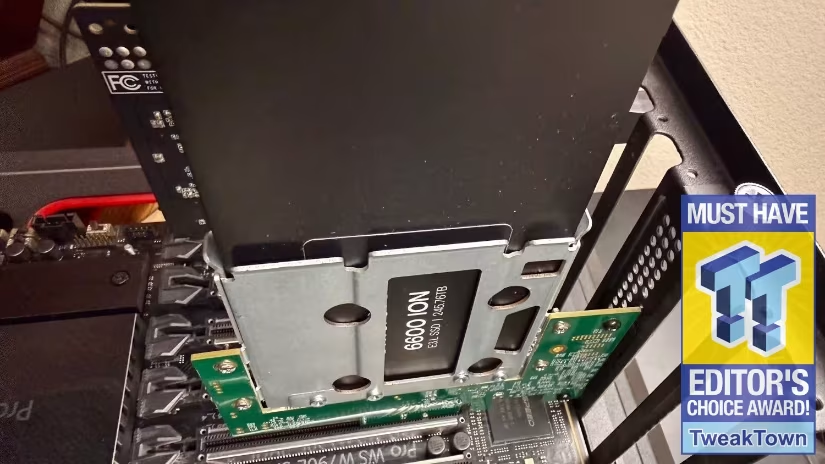
Micron’s 6600 ION enterprise SSD, boasting a capacity of 245.76TB (with 256TB raw), has received an impressive 99% score and the Editor’s Choice award. This recognition stems from its innovative approach to ultra-high-capacity storage, specifically through its redesigned Indirection Unit (IU).
The core innovation lies in Micron’s reduction of the IU to just 16K. The drive utilizes 64GB of onboard DRAM, a significant decrease compared to the industry standard of 64K found in competing 245.76TB drives, which featured only 16GB of DRAM.
This change addresses previous limitations of QLC SSDs optimized for sequential reads but struggling with random writes. Micron’s strategy – fabricating both its own DRAM and NAND – tackled three major challenges: cost, physical footprint, and power draw. Competing vendors faced roadblocks in these areas.
The drive demonstrably exceeded performance specifications. It achieved a sequential read throughput of 13.9GB/s, exceeding the specified 13.7GB/s, and sustained random writes at 51K IOPS at QD256 against a 42K specification.
Notably, the drive performed exceptionally well in mixed workloads—specifically, 70% read/30% write and 50% read/50% write tests. In these scenarios, the 6600 ION delivered more than three times the IOPS of competitors with a 64K IU at the same capacity.
This capability opened up the potential for 245.76TB drives to be utilized in database and email server applications, where they were previously limited by random write performance.
The 6600 ION ships with a PCIe Gen5 x4 E3.L form factor, compliant with NVMe 2.0d specifications and incorporating features such as Full Data Path Protection, Power Failure Protection, and firmware upgrade capabilities without requiring a system reset. It is compatible with operating systems including RHEL, SLES, CentOS, Ubuntu, Windows Server, and VMware ESXi.
The testing environment involved an ASUS Pro WS W790E-SAGE SE motherboard with an Intel Xeon w7-2495X CPU running Ubuntu 24.04.1 LTS.
The verdict highlights the drive’s groundbreaking nature, enabling viable read-heavy mixed workloads at this capacity for the first time. The increased DRAM onboard directly improved random programming performance and the drive delivers four times what is typically packed at this capacity.
It is positioned as the leader in its class, securing recognition as the best of its kind to date. The design allows optimal performance across a variety of application types.