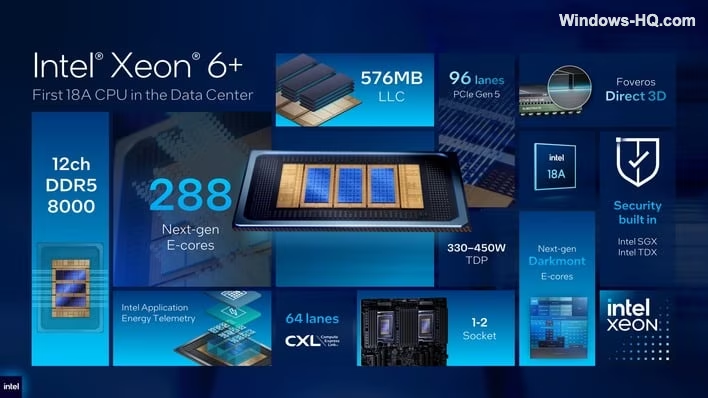
During its Computex showcase, Intel announced several major products, focusing heavily on the data center segment. The headline release was the Intel Xeon 6+ processors, which are codenamed Clearwater Forest. These processors are built on Intel’s most advanced 18A fabrication process and feature up to 288 Darkmont CPU cores in a single socket.
Intel characterizes Xeon 6+ as offering “market-leading rack density” and claiming superior performance per thread. The architecture utilizes E-cores, which do not have Hyper-Threading, allowing Intel to allocate dedicated cores for each thread, contrasting with processors like Zen 5.
In terms of specifications, the Xeon 6+ chips feature up to 288 physical cores (not logical cores), 576 megabytes of last-level cache, and support twelve channels of DDR5 memory running up to 8 GT/s via MRDIMMs. Connectivity includes up to 96 lanes of PCI Express 5.0 and up to 64 lanes of CXL.
Clearwater Forest’s architecture is built using twelve separate compute tiles, fabricated on the 18A process. These tiles are arrayed upon three active base tiles, which are supported by I/O tiles borrowed from the Xeon 6900-series Granite Rapids Xeons. The interconnection is achieved using twelve EMIB tiles with Foveros Direct technology, facilitating ultra-low-latency communications across the entire chip.
Addressing power efficiency, the Clearwater Forest chips incorporate Intel AET, or Application Energy Telemetry. This feature enables datacenter operators to monitor energy consumption at the per-core and per-application level, helping system administrators identify and improve problem workloads.
Comparing the new chips to the first-generation E-core only Xeons, Sierra Forest, Intel reports that the Xeon 6+ features double the CPU core count and significantly increases memory bandwidth and last-level cache, which benefits memory-bound workloads. Additionally, the Xeon 6+ includes cryptographic acceleration instructions for SHA-512, SM3, and SM4 encryption schemes, claiming performance jumps of up to 15× and speeds of up to 6× over the AMD EPYC 9965.
Intel benchmark claims show that the new parts offer a 126% performance uplift over Sierra Forest, alongside 55% better performance per watt. In a comparison with the AMD EPYC 9965, Intel claims superiority in both performance per thread and average performance per thread per watt, though analysis of power consumption suggests the AMD chip was slightly faster overall.
Attention to utilization shows that while a per-thread advantage is valuable, at typical utilization levels of around 40%, Intel claims beating the competing AMD chip by 30% in overall performance per watt.
When summarizing the lineup, Intel noted that Clearwater Forest is highly advantageous for workloads requiring massive multi-core throughput, suggesting that Diamond Rapids might be preferred for extreme single-threaded performance.
Regarding future products, Intel confirmed that the next-generation all-P-core Xeons, Diamond Rapids, are delayed. These chips are slated for next year and are expected to feature 16-channel memory, PCI Express 6.0, up to 192 cores per socket, and a move to the “18A-P” process. The 18A-P process reportedly reduces thermal resistance and offers an 18% efficiency improvement compared to the current 18A process.
Intel also unveiled its new Ethernet E835 network adapter. This NIC uses a PCI Express 5.0 x8 interface and supports up to 200 Gigabits of Ethernet throughput, with configurations ranging from 4x 25-Gigabit up to 1x 200-Gigabit. It is available in an OCP form factor and is claimed to offer nearly double the power efficiency of NVIDIA’s ConnectX-6 adapter.
Another announcement was the update on Crescent Island, the next-generation Intel Data Center GPU. Based on the Xe3P GPU architecture, this card will support datatypes from FP4 to FP64 and support up to 480GB of local memory. Intel’s own add-in cards will have 160GB of memory. Notably, Crescent Island utilizes LPDDR5X instead of GDDR to achieve this massive capacity. It has a 350W TDP in PCIe form factor.
Overall, Intel’s data center showcase highlighted a strategic focus on architectural specialization in the highly competitive datacenter market.