At Computex 2026, AMD presented several announcements targeting the performance-sensitive, budget-conscious gamer demographic. The announcements covered new CPUs, updated memory technology, and refreshed GPUs.
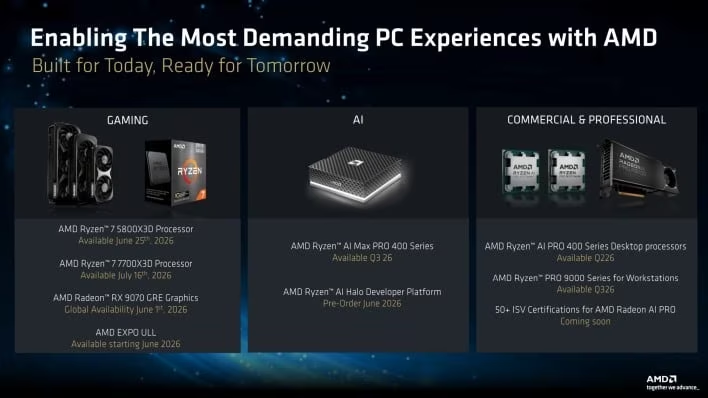
On the CPU front, AMD highlighted the return of the Ryzen 7 5800X3D 10th Anniversary Edition. This processor arrives at e-tail on June 25, 2026, with a suggested e-tail price of $349. It is noted that the silicon is the same as the original release, but AMD is packaging it with a Carbice Ice Pad carbon nanotube thermal pad for optimized cooling.
AMD is positioning the 5800X3D as the best Socket AM4 gaming CPU and an ultimate upgrade path for users with older AM4 motherboards. This strategic move is highlighted as a way to provide a reason for gamers to remain on existing DDR4 platforms amid shortages and high prices for DDR5 memory.
Another key CPU announcement was the Ryzen 7 7700X3D, scheduled for a July 16 launch at $329. This processor is internally described as a Ryzen 7 7800X3D with a 200 MHz cut to its base clock and a 500 MHz cut to its boost clock.
Regarding platform longevity, AMD confirmed that Socket AM5 support will continue through 2029. This longevity is beneficial for AM5 users but also implies that AMD desktop platforms will not see DDR6 memory until 2030 at the earliest.
Memory performance was a major focus with the introduction of EXPO Ultra Low Latency (ULL). Although technical specifications are not yet fully available, AMD describes EXPO ULL as an automatic overclocking technology that will be available soon from various memory manufacturers, including G.SKILL, Teamgroup, Kingston, Adata XPG, and Klevv.
AMD claims that EXPO ULL can offer up to 13 percent better average frame rates and 15 percent better one-percent lows on a Ryzen 7 9700X when compared to standard JEDEC memory. However, the gains against standard EXPO profiles are cited as a modest 4 percent in both average frame rates and one-percent lows.
On the GPU side, AMD re-introduced the Radeon RX 9070 GRE. This card is a cut-down version of the non-XT Radeon RX 9070, featuring 48 compute units (compared to 56) and a 25 percent reduction in the memory bus, resulting in a 192-bit interface and 12GB of GDDR6 VRAM.
AMD positioned the RX 9070 GRE as a potential ‘half-step’ between the RX 9060 XT and the RX 9070. The company claims it delivers 22 percent faster performance than NVIDIA’s GeForce RTX 5060 Ti. Its suggested price is $549.
Finally, AMD also announced that its Radeon AI PRO R9000 graphics products are validated for over 50 certified professional applications across both Windows and Linux. These certifications will be implemented in the upcoming