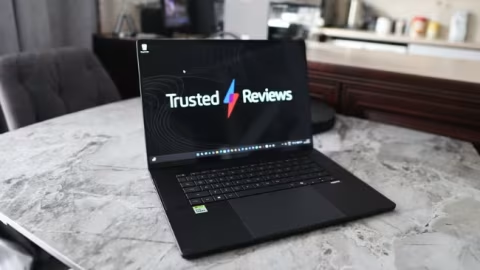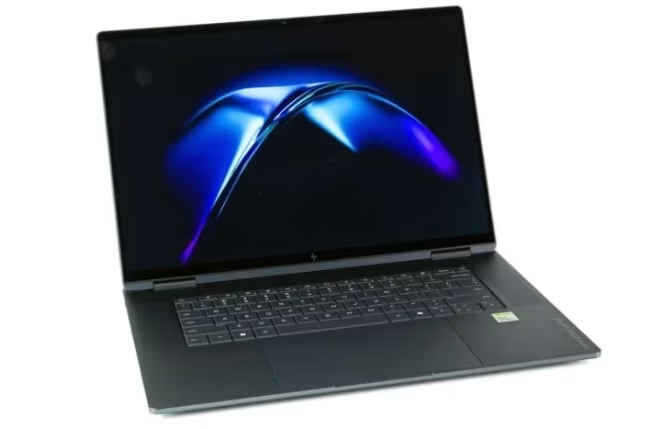
The HP OmniBook Ultra 16 enters the market as the first retail laptop featuring Nvidia’s RTX Spark N1X platform. Industry reviews praise the machine as a “first-class premium AI powerhouse.”
The core specifications are centered around a powerful, unified memory architecture. The laptop pairs a 20-core Nvidia Grace CPU with a Blackwell-derived RTX GPU containing 6,144 CUDA cores. Both components access a single pool of 128 GB of LPDDR5X memory running at 9,400 MT/s, paired with a 2 TB PCIe 5.0 SSD.
This unified memory design is the machine’s defining feature. It allows CPU and GPU workloads to access the same large pool, simplifying large-model deployment and reducing data copies. HP states the device can achieve up to one petaflop of FP4 AI performance for inference workloads.
Physically, the OmniBook Ultra 16 features an all-aluminum, business-like design with CNC unibody construction, earning praise for its overall quality. The 16-inch display is a highlight, boasting an HDR OLED panel that reaches 1,100 nits. It offers a 2,880 × 1,800 resolution and a 16:10 aspect ratio.
The unit weighs 2.22 kg and measures 15.73 mm thick at the rear. The cooling system utilizes two fans and three heatpipes, designed to allow the 20-core RTX Spark to draw up to 70 W, powered by either a 140 W charger or a 99 Wh battery.
Performance reviews reveal a nuanced picture. While HotHardware rates the local AI performance as “outstanding”—noting the CUDA core count exceeds an RTX 5070 Ti and featuring a wider 256-bit memory interface—the N1X is limited to 80 W of thermal design power. This is considerably less than the 100–150 W range typical for discrete GeForce laptop GPUs.
In gaming benchmarks from PCMag, the RTX Spark N1X performs roughly at the level of an RTX 5070, rather than exceeding it. Reviewers note that gaming is not the primary target for these systems, even though Nvidia has partnered with publishers including EA, Capcom, Sega, and Ubisoft to ensure playability.
The drawbacks are significant, particularly given the premium cost. Reviewers flagged the battery life as “mediocre,” and even standard web and office tasks were deemed underwhelming. Furthermore, native Arm64 apps function correctly, but anything requiring emulated execution—including some Windows utilities, games, and x86-specific development tools—may behave differently on the Arm CPU side.
Other criticisms include noticeable fan noise and the fact that the unified memory is not user-upgradable. The starting price of $3,199 for the 32 GB model rises steeply to $6,229, making the device difficult to recommend for users without a specific AI focus.
Ultimately, the OmniBook Ultra 16 serves as a showcase for Nvidia’s Windows-on-Arm ambitions. Its value proposition holds only for professionals whose work heavily relies on local AI inference and CUDA development. For the general user, the combination of high price, battery limitations, and architectural caveats makes the machine challenging to justify.