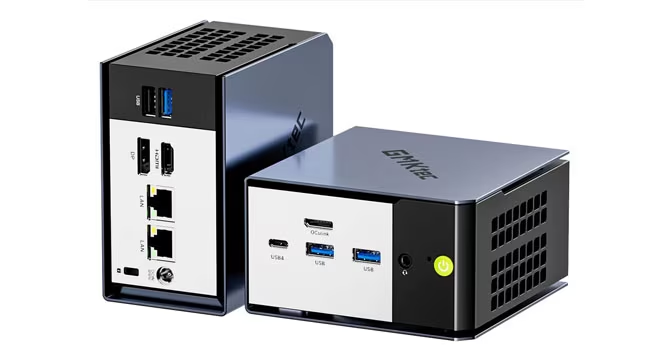
The GMKtec K16 is presented as a small, feature-rich Mini-PC designed for everyday desktop work, media consumption, and lighter gaming. It utilizes the Ryzen 7 7735HS processor and features an integrated Radeon 680M graphics unit.
The device boasts significant connectivity options, including dual 2.5 GbE LAN ports, USB4, HDMI, DisplayPort, Wi-Fi 6E, and Bluetooth 5.2. Furthermore, it includes a rare OCuLink connection for external GPU support, allowing users to expand its graphics capabilities beyond the Radeon 680M.
In terms of memory and storage, the K16 is equipped with 32 GB of onboard LPDDR5-6400 RAM. While this solid amount supports general use, the memory is not upgradeable due to its soldered design. For storage, it offers two M.2 2280 slots for expansion, providing considerable local storage flexibility.
The K16’s performance assessment indicates that for typical day-to-day tasks—such as web browsing, office work, and general multitasking—it is quick enough. However, its CPU results in benchmarks like Cinebench show weakness, and the Radeon 680M lags behind newer Mini-PCs featuring the 780M and 890M units.
Gaming performance is stated to be suitable for casual gaming, older PC titles, and lighter esports games. More demanding modern AAA releases are not recommended, as performance drops off quickly when settings or resolutions increase. The OCuLink port offers a pathway to significantly boost gaming and workstation capabilities by connecting an external GPU setup.
Connectivity remains a key selling point; the inclusion of dual 2.5 GbE LAN and USB4 provides more flexibility than most compact Mini-PCs, and the system supports triple-display setups.
While the metal chassis gives it a sturdy, premium feel, buyers should note that the bundled SSD uses PCIe 3.0 performance, which is slower compared to modern PCIe 4.0 or 5.0 drives. Furthermore, AI and content creation performance are described as modest for a unit positioned in a premium price bracket.
In conclusion, the K16 shines for users who prioritize connectivity, storage flexibility (two M.2 slots), and ultra-compact size alongside solid day-to-day functionality. However, its older generation CPU and GPU relative to new market competitors means it may struggle with heavy professional or high-end gaming workloads. The pricing is noted as potentially high when compared to newer Mini-PCs offering comparable performance per dollar.