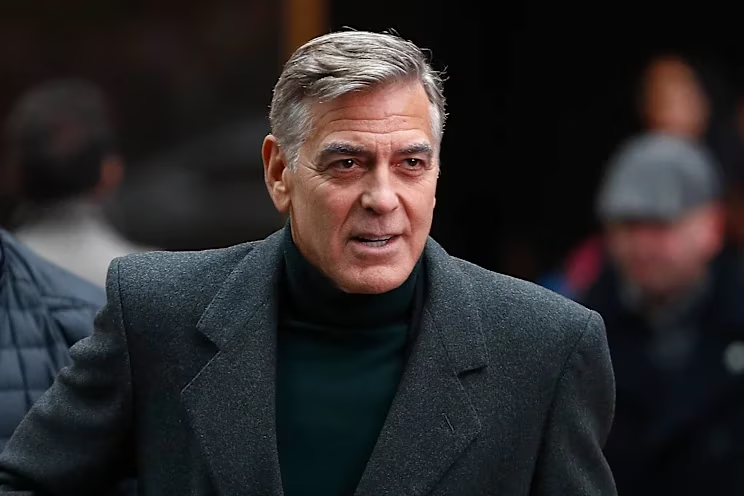
Actor and filmmaker George Clooney has delivered a scathing critique of President Donald Trump’s recent rhetoric regarding Iran, labeling the threat to “end civilization” as an outright crime. Speaking at an event in Cuneo, Italy, before a crowd of 2,700 students, the 64-year-old Academy Award winner argued that while conservative views are valid, there is a fundamental “line of decency” that the current administration has crossed. The controversy stems from Trump’s warning that a “whole civilization” would perish if Tehran failed to comply with demands regarding the Strait of Hormuz.
Clooney’s foundation, in collaboration with the Community Restorative Centre, organized the event where the actor expressed deep concern over the current trajectory of American history. He reflected on his own political influence, specifically referencing his New York Times op-ed that urged Joe Biden to step aside. While some have questioned his role in Trump’s return to power, Clooney noted that the Democratic party’s failure to hold open primaries left voters with their “backs against the wall,” lamenting the “shame” of the process.
A significant portion of the critique focused on the potential dismantling of NATO, an institution Clooney credits with maintaining global safety for decades. Trump has recently accused several key allies—including Australia, South Korea, and Japan—of betraying the United States by refusing to support military action against Iran. Clooney argued that despite past mistakes, the U.S. has achieved “extraordinary things” through these alliances that are now being jeopardized by isolationist policies and aggressive war threats.
The White House was quick to retaliate, with communications director Steven Cheung mocking the actor’s career on social media, suggesting Clooney was the one committing “war crimes” via his filmography. In a composed response to The Hollywood Reporter, Clooney dismissed the “infantile name-calling,” pivoting the conversation back to the legal definition of war crimes under the Genocide Convention. He pointedly asked for a legitimate defense of the administration’s intent to physically destroy a nation, rather than critiques of his performance in Batman & Robin.
This latest exchange is merely the newest chapter in a long-standing feud between the two figures. Trump has previously labeled Clooney a “second-rate movie star” and a “mediocre” talent following the actor’s decision to seek French citizenship. Clooney has often met these insults with sarcasm, once quipping that he agreed with the need to “Make America Great Again” by voting for change. Their public disagreements have spanned several years, covering everything from Clooney’s television interviews to his political prognostications.
The actor’s current stage work also mirrors his real-world political stance. In the theatrical version of Good Night, and Good Luck, Clooney portrays legendary journalist Edward R. Murrow. The play chronicles Murrow’s historical standoff with Senator Joseph McCarthy during the 1950s “Red Scare.” By taking on this role, Clooney highlights the historical dangers of blacklisting and government crusades against journalists and academics, drawing a clear parallel to the modern political climate he now opposes.
Ultimately, Clooney’s stance serves as a plea for a return to decorum in the highest levels of government. By calling out the human cost of war—citing incinerated children and a global economy “on a knife’s edge”—he is attempting to move the debate away from celebrity spats and toward the gravity of international law. As the conflict with Iran continues to dominate the headlines, the tension between Hollywood’s most prominent activist and the Oval Office shows no signs of dissipating.