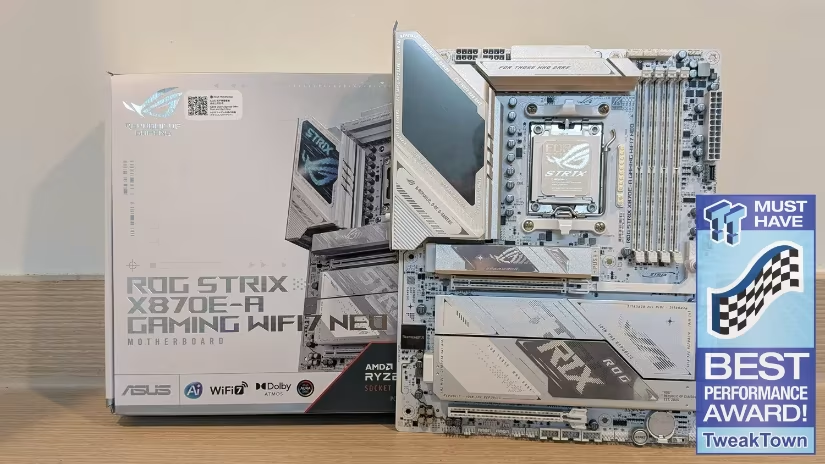
The ASUS ROG Strix X870E-A Gaming WiFi7 Neo is presented as a feature-rich ATX motherboard designed for AMD’s AM5 platform. It supports processors from the Ryzen 7000, 8000, and 9000 series, retailing at $469.
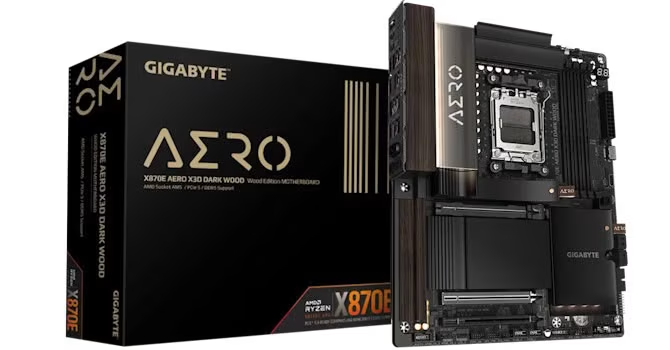
The board features a white and silver design theme, appealing to builders favoring light-coloured systems. However, one review noted that the design appears somewhat busy compared to alternatives such as the GIGABYTE X870E Aero Wood.
Connectivity is extensive, featuring dual USB4 Type-C ports, six 10Gbps USB ports, four 5Gbps USB ports, a 5G LAN port, and WiFi 7 support. Although it supports WiFi 7, the implementation is limited to 160MHz connections rather than the full 320MHz found on some competing models.
The I/O panel includes a single USB-C port with 30W Power Delivery. While the rear I/O supports this, the front USB-C headers are noted to lack official PD support, delivering only up to 15W by default.
Storage capabilities are robust, offering four M.2 slots: two that support PCIe 5.0 and two supporting PCIe 4.0, supplemented by four SATA ports. The main PCIe 5.0 M.2 slot is equipped with a dedicated heatsink utilizing a tool-less mechanism. A single large plate cools the remaining three M.2 slots.
A lane-sharing compromise exists for storage: the second PCIe 5.0 M.2 slot shares bandwidth with the USB4 ports. If the USB4 ports are occupied, this slot runs at x2 by default, though users can adjust it to x4 in the BIOS at the cost of disabling the USB4 connectivity.
The board provides two PCIe x16 expansion slots; the primary supports PCIe 5.0 x16, and the secondary supports PCIe 4.0 up to x4 electrically.
Power delivery is managed by a substantial 16+2+1-phase VRM featuring 90A stages. Reviewers found this power system more than sufficient for overclocking and even high-core-count Ryzen 9 chips. The VRM cooling was strong, reaching only 54 degrees Celsius under full Cinebench load, suggesting superior performance compared to some pricier boards.
The M.2 cooling also performed well in thermal testing, ranking closely with offerings from GIGABYTE. Memory support is comprehensive, accommodating up to 256GB of DDR5 memory at speeds reaching 9600 MT/s or higher. The article noted that for Zen 5 processors, AMD recommends a configuration of 6000-6400 MT/s in 1:1 mode.
Builder features include several user-friendly elements such as the tool-less primary M.2 heatsink and PCIe quick-release mechanism. Additional conveniences are the Wi-Fi EZ-plug for simple antenna installation, M.2 Q-Latches, and ASUS’s Q-Connector system for easier front-panel connections.
A specialized AIO Q-Connector was included, which is compatible with ROG Strix LC IV series coolers by using metal pads between the CPU socket and memory slots. This setup eliminates the need for separate cables for power, LCD control, and ARGB, leading to a cleaner build aesthetic.
Despite these amenities, the board omits a debug LED readout at this price point. On a positive operational note, the 64MB BIOS ROM contains an integrated WiFi driver, simplifying initial setup by negating the need to download drivers from external devices.
The UEFI interface has seen an overhaul with the introduction of Essential Mode, which bridges EZ Mode and Advanced settings for users. The Q-Fan control page offers customization through setting fan curves based on a thermistor sensor reading.
In benchmarking, the X870E-A Neo delivered strong results across various workloads, including rendering, encoding, file compression, and gaming. Its performance was consistent with expectations for an X870E platform using a Ryzen 9 9950X processor, notably scoring highly in titles such as Cyberpunk 2077 and Horizon Zero Dawn.
The reviewer awarded the board a TweakTown Best Performance Award and an overall score of 90%. The detailed scores were: 96% for Performance, 92% for Quality, 88% for Features, and 83% for Value.
Given its $469 price point, the board is considered competitive against rivals like the GIGABYTE X870E AORUS Pro Ice and ASRock X870E Taichi White. It is also significantly cheaper than ASUS’s own ROG Crosshair X870E Dark Hero. The device is assessed as a solid investment due to AMD’s commitment to long-term AM5 support, maintaining relevance for future Zen 6 and possibly Zen 7 CPU generations.