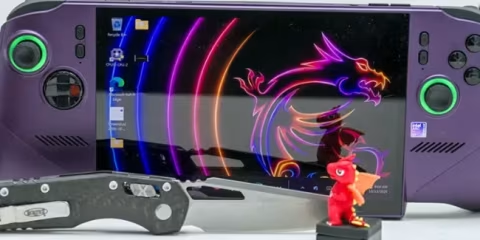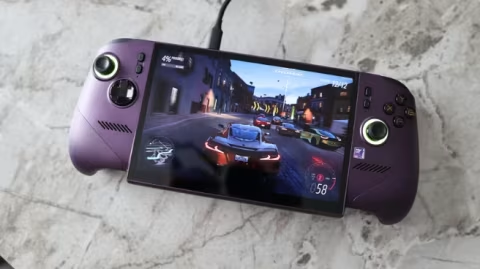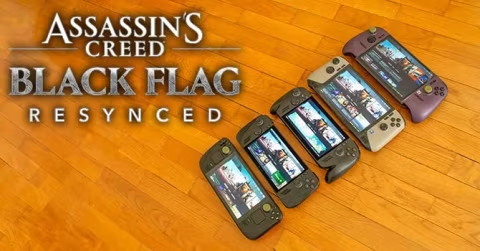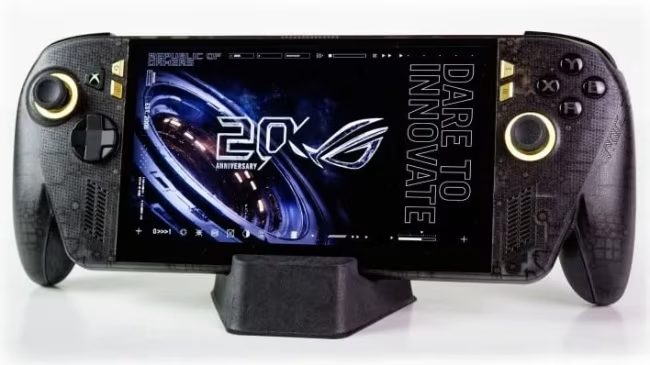
The ASUS ROG Xbox Ally X20 arrived as a collector’s edition celebrating the 20th anniversary of the Republic of Gamers brand. It features several hardware upgrades compared to its predecessor. These changes include a 7.4-inch OLED screen, a translucent gold-and-black chassis, redesigned TMR thumbsticks with tighter deadzones, and a configurable 8-way or 4-way D-pad.
HotHardware noted a thermal redesign that improves airflow by 20 percent over the original Ally X.
Despite the cosmetic and hardware updates, the internal components remain unchanged. The device carries over the Ryzen AI Z2 Extreme silicon, Radeon 890M graphics, and 24GB of LPDDR5X-8000 memory. This means the X20 performs nearly identically to the handheld it replaces.
Reviews consistently point to the OLED panel as the primary attraction. The screen is specified as 1920 by 1080 resolution, 120Hz, supporting VRR and reaching up to 1400 nits peak brightness. Multiple publications describe the image quality improvement as a generational leap.
IGN emphasized that the original Ally X’s screen was always a weak point, and the OLED fundamentally transforms the gaming experience. Notebookcheck likewise called the image quality stunning, affirming a meaningful overall improvement.
Battery life emerged as a quiet win. PCMag tested the X20 for 17 hours and 17 minutes. IGN reported a 2 hour and 43 minute runtime during a Cyberpunk 2077 session, classifying it as the longest-lasting handheld tested, surpassing the original Ally X and the MSI Claw 8 EX AI+.
However, performance remains a key concern. Notebookcheck noted the disappointing performance story, pointing out that the MSI Claw 8 EX AI+ posted a roughly 30 percent performance advantage using Intel’s Arc G3 Extreme.
The price point presents a major hurdle for consumers. The X20 retails for $1,299, a $300 increase over the Ally X, which remains available on sale at $999.
PCMag’s analysis labeled the X20 a cool collector’s item, suggesting the $300 premium is difficult to justify when performance is essentially unchanged. Conversely, IGN argued the screen alone makes the extra $300 worthwhile, though the review also conceded no reason exists to upgrade if the buyer already possesses an Ally X.
Technical shortcomings mentioned across platforms include unresolved CPU scheduling quirks, a lack of Wi-Fi 7 support, and PWM flickering. OC3D also observed that ASUS does not include a charger, which was viewed as inadequate for a device at this price.
The X20’s appeal hinges on the buyer’s priorities. For those prioritizing a premium OLED display, updated controls, and best-in-class battery endurance, the device delivers genuine improvements. But those expecting performance advancements over the previous generation must adjust their expectations, as the higher cost primarily buys aesthetics and improved battery longevity rather than raw frames.