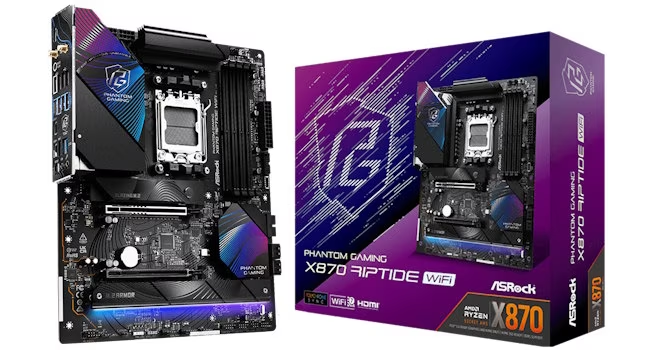
ASRock has recently gained recognition with its range of sub-$300 motherboards, receiving awards for excellent value and performance. The Phantom Gaming X870 Riptide Wi-Fi is highlighted as one of the best-reviewed boards in this category.
The pricing on this motherboard has seen multiple price cuts since its launch. It can be purchased in the US starting from approximately $200, making it one of the most affordable X870 motherboards available there. Conversely, the cost is significantly higher in Europe; for instance, in the UK, it retails around £250.
Choosing an X870 board depends on individual user needs. While options provide high-speed USB ports, including standard USB4, and additional PCIe lanes, users must determine if ASRock meets these requirements without compromising other features, despite the low US price point.
The value proposition varies geographically. In the USA, the Phantom Gaming X870 Riptide Wi-Fi is a cost leader for X870 boards. However, in Europe, it may be less attractive compared to boards from competitors like the ASUS ROG Strix X870-A, Gigabyte X870E Aorus Elite Wi-Fi, and MSI MAG X870 Tomahawk Wi-Fi, which offer more features and better EFIs at a comparable price.
When comparing it to other competition that also offers similar pricing and X870 benefits, the ASRock model is noted for balancing specifications effectively. For instance, compared to the ASUS Prime X870-P Wi-Fi, which has inferior onboard audio and lacks tool-free M.2 heatsinks despite being cheap, the Phantom Gaming board appears superior. Similarly, other boards like the Gigabyte X870 Gaming Wi-Fi6 and MSI X870 Gaming Plus Wi-Fi have been criticized for having inferior audio or lacking specific modern features.
In terms of overall value and preparation for future technology, the Phantom Gaming X870 Riptide Wi-Fi is described as difficult to beat. It addresses essential components that ensure satisfaction as long as Socket AM5 remains relevant, especially given the increasing use of PCIe 5 and Wi-Fi 7.
The board’s credentials are reinforced by its robust cooling for SSDs and VRMs. It handles both PCIe Gen 5 SSDs and 16-core, 170 W TDP CPUs effectively, even when used with cheaper, less demanding components.
Additionally, the inclusion of a USB 3.2 Gen 2×2 20 Gbps Type-C front panel header and a thermistor header adds welcome features considering its price, contributing to a balanced feature set.
However, the board has some drawbacks, primarily related to its EFI and software. These aspects are described as dated and lack certain modern features present on competitor motherboards, which can lead to a complicated or time-consuming building process for some users.
Specific concerns include the main fan control page lacking comprehensive settings beyond the simple fan curve. This makes fine-tuning cooling tedious as it requires switching between different pages. Furthermore, while the associated software is considered slightly more capable than the EFI in terms of fan tuning, it also lacks thorough updates, possibly dating back over a decade.
Despite these technical shortcomings, the board’s performance and features are excellent for most owners. If users do not plan on spending extensive time fine-tuning PC cooling or overclocking, the Phantom Gaming X870 Riptide Wi-Fi provides necessary functionality and strong value.