The TRYX FLOVA F50 arrived at APH Networks in Calgary, Alberta, Canada, having shipped from a third-party broker called Logistar Inc., located in Ontario, California, USA. The shipping container was large and covered the unit, featuring prominent graphics and product details.
Upon opening the box, the TRYX FLOVA F50 is packaged within a transparent plastic bag and protected by open-cell foam brackets. A separate small cardboard box contained documentation and hardware for installation.
Manufacturer specifications indicate that the case measures 481 mm (Depth) x 240 mm (Width) x 501 mm (Height), with materials including steel, TG, plastic, and fabric. It supports Motherboard Sizes: ATX / Micro-ATX / Mini-ITX, and includes support for up to seven PCI-e Expansion Slots.
The case offers ample drive support, accommodating either four 2.5” SSDs or four 3.5” HDDs. Connectivity options include two USB-A 3.2 Gen 1 ports and two USB-C 3.2 Gen 2 ports, plus dedicated audio/mic jacks.
Cooling versatility is a key feature, with support for fans on the top (120 mm x 3 / 140 mm x 2), side, front (multiple sizes available), bottom, and rear. Radiator mounting options include up to 280 mm on the top/front and 360 mm on the front.
The internal design features sufficient cable management space (40 mm) and dust filters on four sides: top, bottom, front, and side.
Installation of a typical system into the TRYX FLOVA F50 was described as standard. The reviewer installed a be quiet! Straight Power 12 1200W power supply at the base, noting that the length allowed substantial space for cabling. Components installed included an ASUS ProArt X870E-Creator Wi-Fi motherboard running with an AMD Ryzen 7 9700X and Crucial Pro Overclocking DDR5-6400 memory kit.
The system utilized a be quiet! Dark Rock Elite cooler, which adheres to the case’s specified maximum air cooler height of 170 mm. The EVGA GeForce RTX 3070 Ti XC3 ULTRA GAMING was mounted in the top slot; its 286mm length fit comfortably within the 360mm clearance.
The cabling process involved relocating two Velcro straps to secure the EPS 8-pin cables, leaving one central strap for general wire management. The builder noted that after all components were installed and secured, there was ample remaining space in the rear.
Regarding acoustics, the TRYX FLOVA F50 recorded a sound level of 7.0/10 during full-speed turbo mode and a quieter 3.0/10 in normal operation, according to APH Networks’ sound scale.
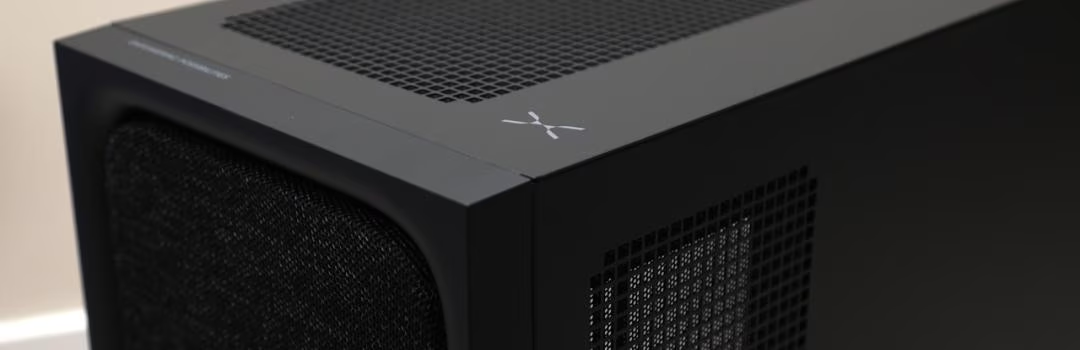
The Cross Flow fan created a noticeable slight rattling noise at full blast. The ROTA 120 fan produced a higher pitched sound that was distinct from the typical low computer hum. Sound suppression is provided via a fabric panel, but no other acoustic measures were present.
In terms of performance testing, when running at full speed, the Cross Flow and ROTA 120 fans measured 44.3dB(A) at a 50cm distance. The large fan column achieved a maximum airflow speed of 17.2km/h (10.7mph), while the ROTA 120 fan reached 14km/h (8.7mph).
The review concluded that visually, the enclosure maintains a familiar boxy structure, but the incorporation of fabric panels adds aesthetic variation. Internally, the case was praised for its functional details, including adequate routing holes and supporting features for various cooling sizes and motherboard connections.
Potential areas for improvement noted by the reviewer include the loudness of both fans at full speed, occasional flexing of steel and plastic elements that could be strengthened, and a request for an integrated graphics card bracket within the case.