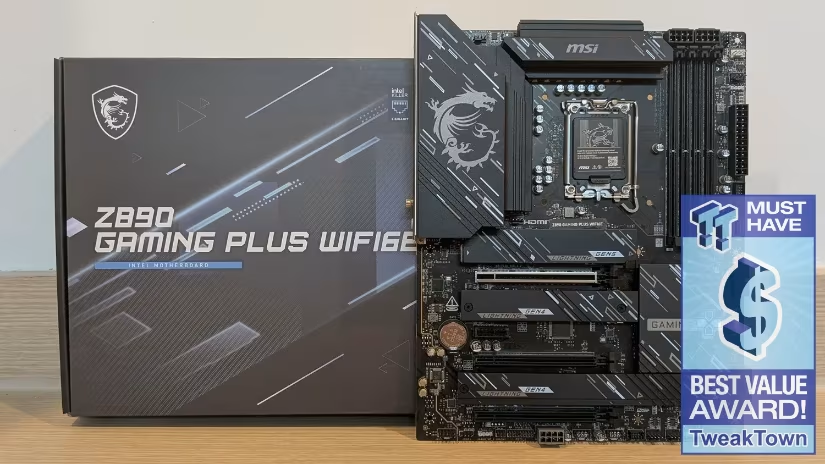
TweakTown reviewed the MSI Z890 Gaming Plus WIFI6E, describing it as a value-focused ATX motherboard designed for Intel’s LGA1851 platform. Priced at an MSRP of $199, the board integrates the Z890 chipset with numerous features, including 5G networking and Wi-Fi 6E support. It also provides connectivity via four M.2 slots and robust support for high-speed DDR5 memory.
The motherboard is built to support Intel Core Ultra 200 series processors. The system includes four DDR5 DIMM slots capable of supporting up to 256GB of memory. Memory speeds can exceed DDR5-9200 through overclocking, accommodating non-ECC CUDIMMs and conventional clocked unbuffered DIMMs.
For expansion, the board offers three full-length PCIe x16 slots and one dedicated PCIe x1 slot. The primary x16 slot runs at PCIe 5.0 x16 directly from the CPU, while the other two full-length slots operate electrically at PCIe 4.0 x4. TweakTown noted that these four expansion slots offer significant room for multiple cards alongside a graphics card.
The storage configuration is comprehensive, featuring four M.2 slots and four SATA ports. The primary M.2 slot supports PCIe 5.0 x4, and the remaining three support PCIe 4.0 x4. The main M.2 heatsink utilizes a quick-release mechanism, while the other heatsinks are secured traditionally with screws.
A key point of criticism was the M.2 cooling system itself. TweakTown found that the primary SSD heatsink had limited surface area and recorded the highest SSD temperature among tested boards. The reviewer stressed the need for adequate case airflow, particularly for systems running sustained heavy workloads.
The power delivery is handled by a 14+1+1-phase VRM featuring 55A power stages. TweakTown deemed this delivery more than sufficient for an Intel Core Ultra 7 270K Plus, even with some overclocking headroom. The VRM heatsink performed substantially better than the SSD cooling, recording a peak temperature of only 57 degrees.
Connectivity is strong; wired networking is provided by an Intel Killer E5000 5G controller, complemented by Intel Wi-Fi 6E and Bluetooth 5.3. Integrated graphics support DisplayPort 1.4 and HDMI 2.1 outputs for Core Ultra processors.
The USB ports include a rear I/O selection of two 10Gbps ports, two 5Gbps ports, and four USB 2.0 ports. Internally, the board provides a USB Type-C 20Gbps connection, along with headers for four 5Gbps and four USB 2.0 connections. The 20Gbps internal connection is noted as the fastest USB interface available.
Audio functionality is managed by a Realtek ALC897 codec, which includes both 3.5mm line-in and line-out connections. Although lacking built-in RGB lighting, MSI provides three ARGB headers and one 12V RGB header, alongside seven general fan headers.
The design features practical elements such as a quick-release mechanism for the primary heatsink, tool-free installation of an M.2 drive, and an extended release mechanism for the main PCIe slot. Four diagnostic LEDs are located beside the 24-pin power connector.
MSI’s UEFI was reviewed positively. The BIOS utilizes the company’s newer layout found on its 800-series boards. It features an EZ Mode page providing access to settings like XMP, automatic overclocking, boot priority, and fan controls. TweakTown also praised the Hardware Monitoring page for its ease of navigation.
TweakTown conducted testing using an Intel Core Ultra 7 270K Plus CPU and an MSI GeForce RTX 4070 Ti Super graphics card. Across rendering, encoding, compression, memory, and gaming tests, the board’s performance was generally deemed appropriate for its platform. The review noted that differences between Z890 motherboards were often minimal, with CPU and memory configurations having a greater influence on results.
The final assessment heavily emphasized the $199 price point. TweakTown commended the combination of strong VRM, 5G LAN, high-speed memory support, four expansion slots, and broad storage configuration, noting that the board concentrates on core features rather than expensive extras. It received a score of 92% overall.
The review concluded that, provided users maintain adequate airflow around the M.2 storage, the motherboard offers strong expansion potential and can accommodate high-end components while supporting overclocking.