Vivo has launched the X Fold 6, a new book-style foldable smartphone, into international markets including Europe and India. The device follows its initial rollout in China in June 2026.
The phone adheres to a more traditional, taller book-style form factor, unlike the recent shift toward squatter, passport-style designs seen in competitors like the Samsung Galaxy Z Fold 8 and Xiaomi 18 Fold. Despite this older style, the X Fold 6 is described as a comfortable and powerful foldable with useful multitasking features and excellent cameras.
In terms of physical dimensions, the X Fold 6 measures 4.4mm thick when unfolded in Prism Black and 4.8mm in Horizon Blue. When folded, it is 9.4mm (Black) and 9.9mm (Blue). Weighing 228g in black and 235g in blue, it utilizes Vivo’s Ultra-Reliable Lightweight Hinge, which reviewers noted for its smooth operation and ability to hold the display open at varying angles.
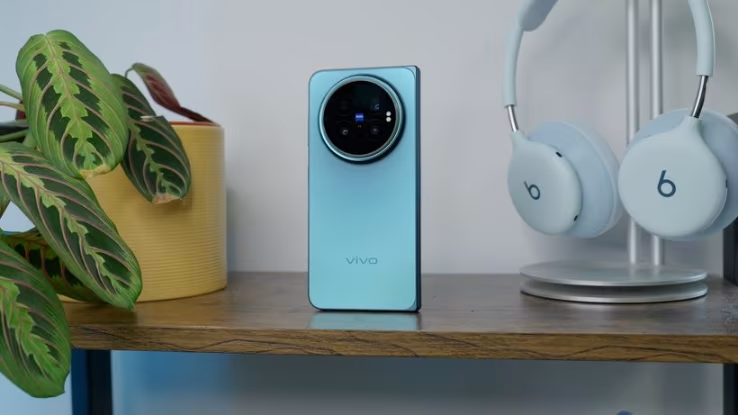
The design shares elements with Vivo’s sister brand Oppo, including a symmetrical circular camera mound and characteristic aluminum frame shaping. However, the reviewer pointed out that the Vivo model is shorter and wider than the Oppo Find N6 and the Samsung Galaxy Z Fold 8 Ultra, giving its cover display a less narrow, more comfortable feel.
The X Fold 6 supports three color variants: Blue Hole, Salt Lake, and a standard black option. The Horizon Blue version ships with a vibrant green-blue protective case.
The displays themselves are substantial. The phone features an 8.02-inch inner screen and a 6.51-inch cover display. Both use AMOLED panels with 1-120Hz adaptive refresh rates and 10.7 billion colors. The inner display has a resolution of 2504 x 2312 pixels, while the cover screen offers 2528 x 1120 pixels.
Powered by Samsung’s M14 material internally and BOE’s Q11 material on the cover screen, both panels are designed for high brightness, reaching up to 5,000 nits of local peak brightness. While testing showed the panels did not achieve the full 5,000 nits, they remain easy to read outdoors. The panel technology incorporates high-frequency PWM dimming, which helps with eye strain, though one report noted an underlying flicker at a low 90 Hz.
Driving the hardware is MediaTek’s Dimensity 9500 Super Edition chipset. This 3nm eight-core processor clocks at a peak of 4.21GHz and features ARM’s G1-Ultra GPU. Users have the choice of 12GB or 16GB of LPDDR5X Ultra RAM coupled with 256GB, 512GB, or 1TB of UFS 4.1 storage. Vivo co-developed this chip specifically for large-screen AI multitasking scenarios.
While benchmark scores show the SoC offers plenty of performance, cooling remains a concern. After 15 minutes of continuous load, benchmark scores saw a notable drop, indicating thermal throttling under sustained pressure.
The camera system is highlighted as a major strength. It utilizes a triple-camera rear setup: a 200MP ZEISS main camera with OIS and ZEISS T* coating, a 50MP ZEISS APO periscope telephoto camera offering 3x optical zoom and OIS, and a 50MP ZEISS ultra-wide camera. The device also includes two 20MP selfie cameras, located on both the inner and cover displays.
The primary 200MP lens, which has a slightly larger sensor than its predecessor, delivers detailed and natural-looking photos. The optical zoom yields good results, and the phone supports up to 100x ZEISS HyperZoom. Despite the strong camera hardware, one key drawback noted was visible condensation inside the main sensor lens during testing.
Battery endurance is another standout feature. The global version ships with a 6,900mAh BlueVolt battery, which uses fifth-generation silicon-anode technology and a semi-solid-state design. It supports 80W wired FlashCharge and 40W wireless charging. In one round of testing, the phone achieved an autonomy of 14 hours and 44 minutes unfolded and 17 hours and 44 minutes folded. Despite these respectable figures, the X Fold 6 was outperformed by other major foldable models.
The device operates on Vivo’s OriginOS 7. This software is described as well-optimized for the flexible, large display, supporting multi-app tasks through Origin Workbench and a laptop-style trackpad mode.