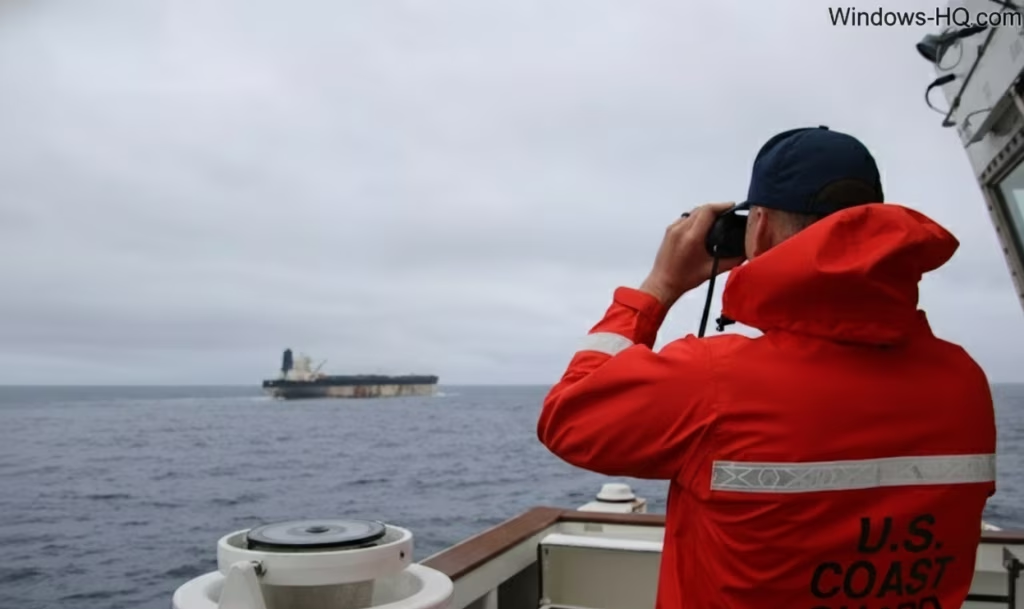
Recently, the United States boarded a ship sailing under a Russian flag, an event that has sparked significant discussion regarding the legal framework governing such actions on the high seas. While details remain somewhat limited, the incident raises crucial questions about maritime law, national security interests, and the escalating tensions between the US and Russia.
The legality of boarding a foreign-flagged vessel is generally governed by international law, primarily the United Nations Convention on the Law of the Sea (UNCLOS). Under UNCLOS, ships generally enjoy the right of free passage on the high seas, and interference by other states is restricted. However, there are exceptions to this rule, such as when there is reasonable suspicion of piracy, slave trade, or other serious crimes.
The specific reasons for the US boarding the Russian-flagged ship have not been fully disclosed. Possible justifications could include suspicion of carrying contraband, violating sanctions, or engaging in activities that threaten US national security. Without concrete evidence, it is difficult to definitively assess the legality of the action under international law.
Another critical aspect is the ship’s location at the time of the boarding. If the vessel was in international waters, the legal threshold for intervention is higher than if it were within a state’s territorial waters or exclusive economic zone (EEZ). If it was within Russia’s EEZ, then intervention would be a violation of international law.
Furthermore, the nature of the ‘boarding’ itself is relevant. Was it a brief inspection, or did it involve a prolonged search and seizure? The extent of the intrusion impacts the legal assessment. A brief verification of documents might be permissible under certain circumstances, while a full-scale search would require stronger justification.
The incident also occurs against a backdrop of heightened geopolitical tensions. Relations between the US and Russia are strained due to various issues, including the conflict in Ukraine, accusations of election interference, and differing views on international security. This context inevitably influences the interpretation of the legal implications and potential ramifications of the ship boarding.
What we don’t know is arguably as important as what we do know. The US government has released limited information, leaving room for speculation. It is unclear what evidence, if any, prompted the boarding, what was discovered during the search, and what diplomatic communications have occurred between the US and Russia following the incident.
The lack of transparency also makes it challenging to assess the action’s potential impact on international relations. Russia may view the boarding as an act of aggression and respond with countermeasures, potentially escalating tensions further. Alternatively, if the US can provide compelling evidence of illegal activity, it may garner support from other nations.
Regardless of the specific circumstances, the boarding of a Russian-flagged ship by the US serves as a reminder of the complexities and potential for conflict in maritime law. It underscores the importance of clear communication, adherence to international norms, and the need for transparency in addressing potential violations on the high seas. As more details emerge, a more comprehensive legal assessment will be possible.