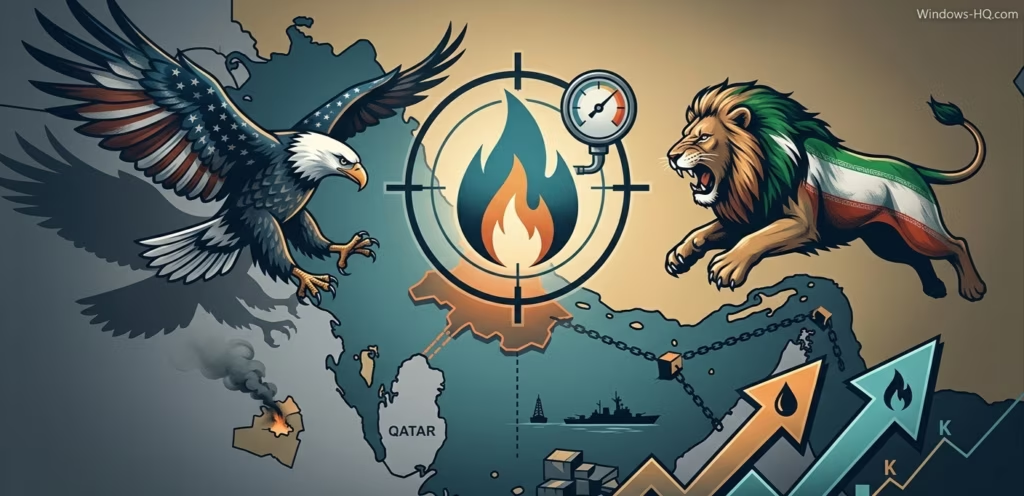
US President Donald Trump has warned that the United States will “massively blow up” Iran’s South Pars gasfield if Tehran launches further attacks on Qatar’s gas facilities. The threat follows an Israeli strike on the Iranian site on Wednesday, which prompted Iran to retaliate against energy infrastructure across the Middle East.
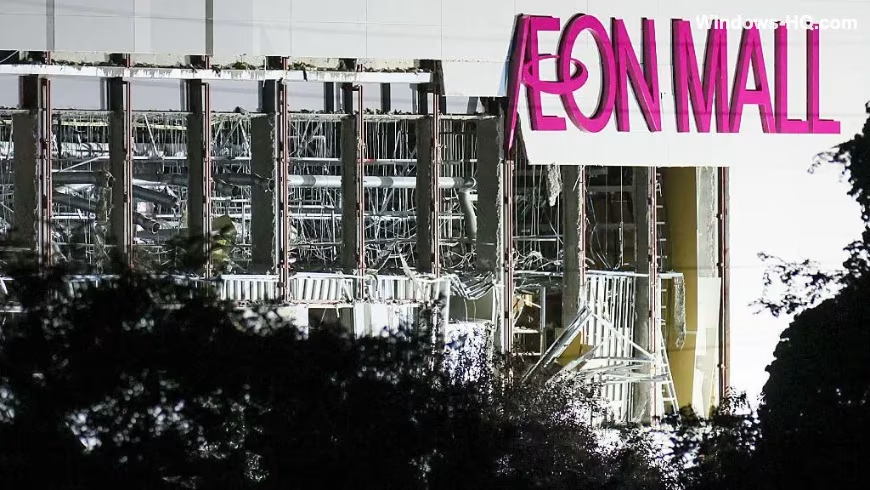
The Israeli targeting of South Pars, which Iran shares with Qatar, represents the first attack on Iranian fossil fuel production since the conflict began nearly three weeks ago. In response, Iran struck the world’s largest liquefied natural gas hub at Ras Laffan in Qatar. State-run QatarEnergy reported “sizeable fires” and extensive damage at multiple facilities, though the Qatari interior ministry later confirmed all fires had been contained.
Trump claimed on social media that the United States “knew nothing” of the Israeli attack, contradicting earlier US media reports that he had approved the strike to pressure Tehran into reopening the Strait of Hormuz. The president also stated that Qatar had no prior knowledge of or involvement in the Israeli operation.
According to Trump, Israel will refrain from targeting South Pars again unless Iran resumes attacks on Qatari gas infrastructure. However, he warned that any Iranian retaliation would result in the complete destruction of the gasfield with “strength and power that Iran has never seen or witnessed before,” with or without Israeli assistance.
The escalating violence has severely disrupted regional energy operations. Authorities in Abu Dhabi shut down operations at the Habshan gas facility and the Bab field following Iranian strikes. Saudi Arabia was also targeted by Iranian ballistic missiles on Wednesday, leading Foreign Minister Prince Faisal bin Farhan to declare that any trust with Tehran had been shattered and that the kingdom reserves the right to take military action.
Diplomatic leaders have condemned the escalation. Foreign ministries in both Qatar and the United Arab Emirates described the Israeli strike on South Pars as a dangerous escalation that directly threatens global energy security. French President Emmanuel Macron conferred with Trump and Qatari Emir Sheikh Tamim bin Hamad al-Thani, calling for a moratorium on military strikes affecting civilian infrastructure and energy supplies.
The conflict’s impact on global markets has been immediate, with international oil benchmark Brent crude surging 3.9% to $111.51 per barrel. Stock markets in Asia also fell, with Japan’s Nikkei 225 dropping 2.5%.
Shipping routes remain severely affected, as the Strait of Hormuz is almost entirely closed. The UK Maritime Trade Operations agency reported that a vessel off the coast of the UAE caught fire late Wednesday after being struck by a projectile. Trump’s attempts to organize a multinational naval force to secure the waterway have not yet succeeded.
Violence continues across multiple fronts in the region. In the occupied West Bank, an Iranian missile attack late Wednesday killed three Palestinian women, marking the first deadly Iranian strike in the territory since the war began.
Meanwhile, the European Union has urged Israel to halt its military operations in Lebanon, where Hezbollah rocket attacks previously drew the country into the crisis. According to Lebanese authorities, Israeli retaliatory strikes have killed at least 968 people and displaced more than a million.
As the conflict drags on, businesses are preparing for continued disruptions. Citing the developing situation, Cathay Pacific suspended all flights to and from Dubai and Riyadh until the end of April.