The TerraMaster D1 SSD Pro is a high-performance M.2 NVMe SSD enclosure designed to convert standard internal SSDs into rugged, portable storage. It aims to provide the performance of 80 Gbps-class enclosures without relying on active cooling fans.
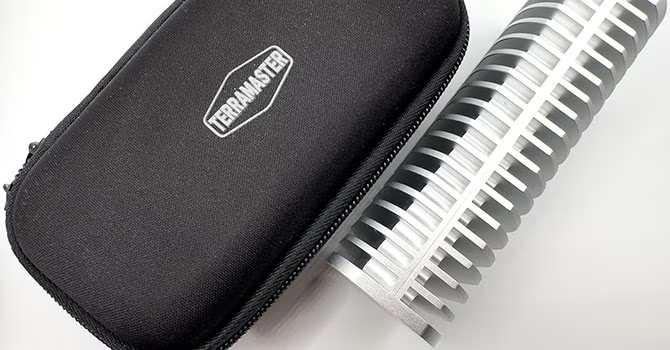
Instead of fans, the enclosure utilizes its chunky, ridged anodized aluminum body for passive cooling, serving as a heatsink for both the M.2 NVMe SSD and the internal bridge chips.
The D1 SSD Pro supports high-speed interfaces, including 80 Gbps Thunderbolt 5 and USB4 V2. It maintains backward compatibility with older standards, such as 40 Gbps USB4, Thunderbolt 3/4, and down to USB 2.0. The device features an LED indicator that glows white when using an 80 Gbps-capable interface and turns amber when using a slower interface.
Internally, the enclosure connects an M.2-2280 SSD with a PCIe (NVMe) interface using a PCI-Express 4.0 x4 host interface, which connects upstream via an Intel JHL9480 ‘Barlow Ridge’ bridge chip. Although the JHL9480 chip physically only outputs PCIe Gen 4 x4, the overall upstream bandwidth is 80 Gbps, enabling the enclosure to theoretically maximize the performance of any M.2 Gen 4 SSD, while also supporting Gen 5 SSDs, which perform as if in a Gen 4 slot.
Testing was conducted using an ASUS ThunderboltEX 5 add-on card and a Samsung 990 PRO 1 TB SSD. The testing confirmed that the TerraMaster D1 SSD Pro utilizes the full 80 Gbps bandwidth. Results showed sequential read speeds exceeding 6.2 GB/s and sequential write speeds over 5.2 GB/s. Furthermore, a mixed load test (50% read/write) achieved sequential transfer rates well above 7 GB/s, performance not achievable with Thunderbolt 4.
Compared to its competitor, the OWC Envoy Ultra, the D1 SSD Pro paired with a Samsung 990 Pro achieved a reported 4% performance gain across all tested metrics. The report noted that while the D1 SSD Pro is faster than the OWC Envoy Ultra, it does not fully max out the Samsung 990 Pro when compared to the drive installed directly on a motherboard, though the SSD was not observed to be running into thermal limits during sustained write operations.
In terms of usability, the enclosure is described as easy to install and portable, though its weight (300 g) means it is better suited for placement on a desk than for brief carry-around file transfers. A notable inclusion is the TPC Backupper software, which is available for download and provides utilities such as whole-disk cloning, system backups, and basic data synchronization.
Potential limitations include a maximum SSD capacity limit of 8 TB, contrasting with 40 Gbps-class enclosures that can support up to 16 TB. Additionally, the D1 SSD Pro does not support smaller M.2 form factors such as M.2-2242 or M.2-2230. Other minor points mentioned are that the included Nylon case does not fit the screwdriver, requiring the user to carry it separately. Despite these considerations, the D1 SSD Pro is positioned as a premium option, especially for content creators who prefer a fanless design, offering 80 Gbps bandwidth without the noise of a fan-based solution.