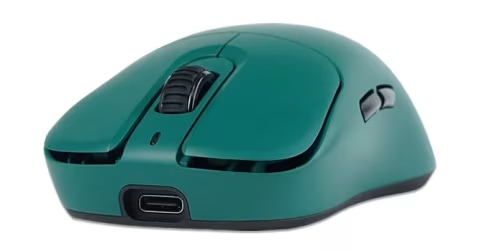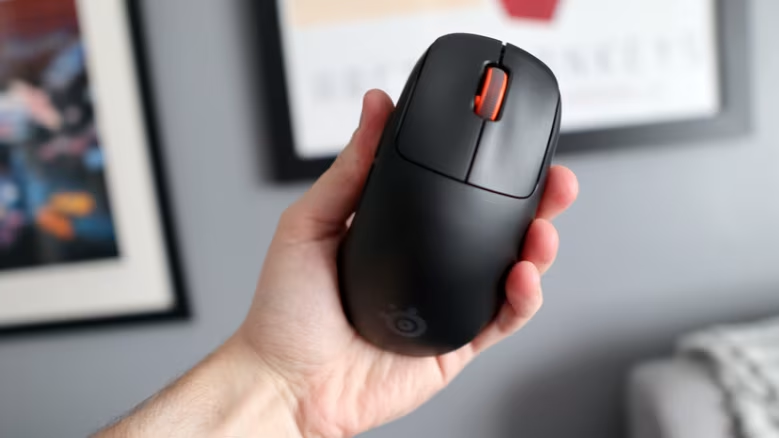
The SteelSeries Rival Pro is positioned as a return to the top tier of competitive gaming mice. Trusted Reviews deems it an immense choice for users seeking a flagship wireless mouse with an ergonomic slant. It is priced at £169.99, $179.99, or €199.99, placing it at the premium end of the market against competitors like the Razer Viper V4 Pro and Logitech G Pro X2 Superstrike.
The defining characteristic of the Rival Pro is its ergonomic shape. Unlike many flagship esports mice that favor a neutral, symmetrical design, the Rival Pro is built for comfort and stability in the hand, particularly for palm grippers. PC Gamer called the mouse “the comfiest mouse” for palm-grip users, setting its shape apart from rivals in a pleasant manner.
The mouse is one of the lightest gaming mice available. The black version weighs 53g, while the white version weighs 54g. The chassis feels solid and well-built, with no creaking or flex. The weight distribution is carefully tuned to ensure balance during rapid movements.
Functionality is managed via two main click buttons, a scroll wheel, and two thumb buttons on the left side. SteelSeries moved the DPI and power buttons to the underside of the mouse. Gaming Trend criticized this move, noting that it requires lifting the mouse to change sensitivity, though it keeps the top surface clear of accidental inputs.
Under the hood, the Rival Pro uses SteelSeries’ custom TrueMove 42K Pro optical sensor, a modified PixArt 3955. This sensor is capable of 42,000 DPI, 800 IPS tracking speed, and 70G acceleration. Reviewers describe the sensor as “zippy” and immensely responsive. It allows for incredibly granular DPI adjustments, down to single-digit increments.
Flagship competitive mice often utilize high polling rates. The Rival Pro supports true 8000Hz polling, which Gaming Trend calls “flawless.” The manufacturer also includes 9K over-polling, which ensures the most stable 8KHz signal possible.
Connectivity relies on Ultra Wide Band (UWB) wireless technology, operating between 6.4GHz and 9.056GHz instead of the traditional 2.4GHz band. This technology grants the mouse roughly 20 times the bandwidth and lower latency than conventional wireless mice. Trusted Reviews praised the UWB connection as responsive and a clever solution to interference problems.
The mouse includes a large USB base station that functions as both the UWB receiver and a charging dock for swappable batteries. The base station also includes a button allowing users to toggle between different performance modes without opening software.
The swappable battery system is a standout feature. Two battery pucks are included in the box. Each battery provides up to 16 hours of use at 8000Hz polling or up to 60 hours at 1000Hz. The batteries lock into place in both the mouse and the base station. Swapping them is a quick, tool-free process. Testing showed users swapping the batteries at least six times during a few weeks of use.